Ecologist Dr. Rae Wynn Grant On Breaking Barriers In Male Fields
‘Change Is Possible’ — Dr. Rae Wynn-Grant On Breaking Barriers As The First Black Woman To Co-Host A National Nature Show [Exclusive] - Page 2
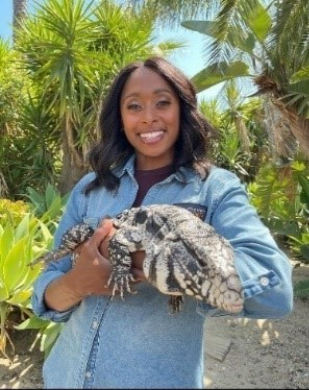
Dr. Rae Wynn-Grant isn’t just making history, she’s expanding what’s possible. As the first Black woman to co-host a national broadcast nature show, she’s stepping into a space that hasn’t always made room for women who look like her and doing it with purpose. But her story didn’t start on television. It started with a young girl in San Francisco who dared to imagine herself in a world she rarely saw reflected back.
Today, that vision has come full circle. Dr. Rae is a wildlife ecologist, author of Wild Life, and co-host of Mutual of Omaha’s Wild Kingdom: Protecting the Wild, bringing science, storytelling, and representation into living rooms across the country. She also lends her voice to PBS Nature’s Going Wild podcast, further cementing her role as a bridge between science and culture.
Her journey wasn’t linear, from a “rural-urban” upbringing to some of the most prestigious academic institutions in the country. It required resilience, recalibration, and a deep belief in her own path, even when the odds suggested otherwise. Now, she’s using her visibility to do more than break barriers: she’s creating access, shifting narratives, and making sure the next generation doesn’t have to navigate these spaces alone.
In this MadameNoire exclusive, Dr. Rae gets candid about the reality of being “the first,” the power of representation in shaping who feels they belong in STEM, and the intentional ways women, especially Black women, can build careers in male-dominated fields that are not only successful but sustainable.
RELATED CONTENT: Dystany Spurlock To Make History As First Black Woman Driver to Compete in NASCAR’s ARCA – ‘I’m Here, And I’m Ready’
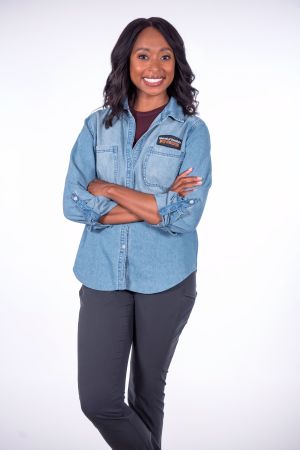
MadameNoire: As the first Black woman to co-host a national broadcast nature show, what are three practical strategies women can use to break barriers in male-dominated fields without shrinking themselves?
1. Prioritize your mental health, especially if you’re a Black woman.
I think women, especially women in their 30s and 40s, often sacrifice wellness, self-care, and particularly their mental health, for pushing through a career, or through trying to gain leadership. Leadership, that we deserve to have. And that we’re worthy of.
Black women are trying to achieve within a white-dominated, white supremacist, patriarchal system. Our mental health suffers just from what we see on the news. Every time there’s police brutality to Black folks, every time the president does some racist thing, every time there is stuff going on, we absorb it and we hold it. And if we’re also fighting in our careers, and we’re fighting to be seen, and to rise in power and influence, it’s just a lot of difficulty all the time.
When I introduced therapy, just regular weekly talk into my life, my world changed, and I was a much better professional. It was because I had this important outlet for all of the emotional stuff that I, as a Black woman, millennial, was carrying.
2. Understand that you have time
Society often tells us there’s this biological clock that’s ticking, this career clock that’s ticking. Social media makes us think, if we’re not famous today, it’ll never happen.
There are statistics out there that say the average woman millionaire achieves that status at age 49. The average woman has a major career pivot at 42. There are all these things that happen in middle age that we sometimes think need to happen in our 20s or early 30s. But it’s really late 40s, 50s. I think women’s careers often solidify in their 60s. Just understand that we do have time. You don’t have to rush your life or your career.
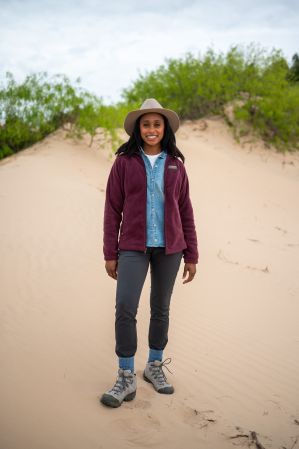
3. Fake confidence until you actually feel it
I used to be in presentations and just look around and think, God, everyone else is smarter than me. It was Rihanna, I believe, who said something about how she fakes confidence. One of her practices is to think to herself: “What would a confident person say in this situation? What would a confident person do? How would a confident person sit in this chair?”
I heard her say that, and I started thinking, okay, if I’m at a meeting and I want to be seen as a leader, a professional, the future of this company, how do I sit in this chair? I stopped sitting upright and proper, and I started just putting one arm back. I’m faking it, because I’m nervous and worried, but I realize, oh yeah, this looks like I’m relaxed and pretty confident. Now I do that all the time.
A lot of people say when I’m on stages and I’m speaking, they’re like, do you ever get nervous? And I’m like, I am so nervous. But I want to make sure that I look like what people think a confident person looks like, because then they believe that about me, and then I start to believe it about myself.
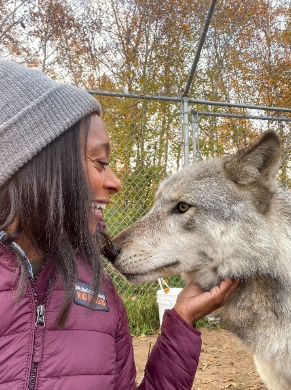
How powerful is media in shaping who believes they belong in science?
I believe media teaches us what we’re not taught in a formal setting. You learn what you learn in school, and almost everything else you get from your family, your community, and the media.
If we see TV shows where one group of people is always depicted in a certain way, and another group is always depicted in a certain way, we are going to believe that, whether it’s true or not. The media needs to take more responsibility in making sure that there is representation. Race shouldn’t matter. I hate that it does, but it does.
Being an expert in wildlife stuff can look a lot of different ways. It can look like how I do it, deep in the wilderness, getting my hands on animals, but it can also look like coding on a computer, or being an artist, or an educator, or a writer, or a journalist. There are so many different ways that people participate in wildlife ecology and conservation, and I wish the media could shed more light on that, so that everyone believes that they belong in whatever kind of field they’re interested in.
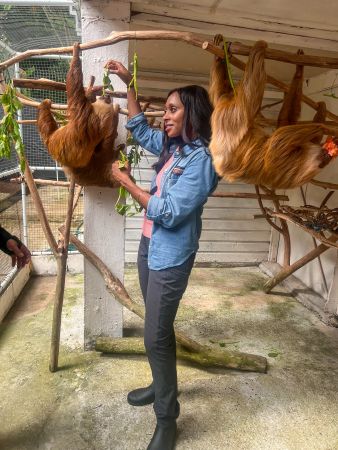
What would you tell women who are wondering how to sustain and manage burnout?
I get this question a lot because there’s a perception that I have that figured out, and I don’t. I’m a mom, I have a 10-year-old and a 5-year-old, two girls, and they’re wonderful. But I do burn out sometimes, and when I do it, it’s very messy. It is not like a cute little, oh, I need to take a lot of naps this weekend.
Sometimes burnout looks like my 10-year-old going through puberty, a lot changing in her social life, and I realize my lack of presence has made a negative impact. And sometimes burnout is health, where my physical health is in the trash can, and it’s not going to take four days to get it back, it’s going to take four months.
Some of the best advice I ever got was from a mentor who talked about, instead of a scale trying to balance, thinking of work and life as a pendulum. Sometimes that pendulum is going to swing way more towards time at work. And sometimes it’s going to swing way more towards family and personal life. Sometimes it will actually be quite balanced in the middle.
Right now, I’m on week three of four straight weeks of travel. My pendulum’s all the way on the work side, 100 percent. But then, for the month of January, I was at home, and my pendulum was 100 percent creating my home life and syncing in with my family.
I still need the advice. I’m still figuring it out. And unfortunately, I still sometimes have these mini crises where I feel like I’m making all of the wrong decisions, and I have to spend some time with myself, finding stillness, and forgiveness, and grace.
If a young Black girl watching Wild Kingdom suddenly sees herself in science because she sees you, what do you hope she believes is possible?
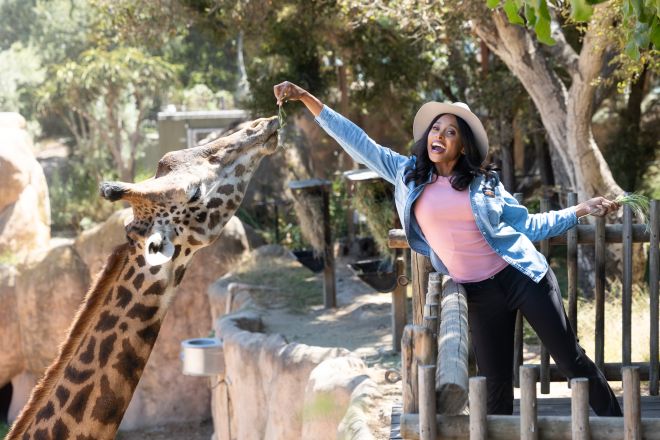
I really hope that she would believe that things can change. Me being the first, and right now the only Black person hosting a nature show, really means that in the last three years, something major changed on TV.
Of course, I hope a little Black girl says, I want to do that, and I can. I want every little Black girl to be a wildlife ecologist. But bigger picture, I want Black youth, I want people of the world to know that change is possible. When you’re a kid, don’t worry about careers, don’t concern yourself with job stuff, but do know that if something doesn’t seem possible when you’re a kid, society can change by the time you’re an adult to make it possible.
You don’t really want the world to be the same from when you’re five to when you’re 25. You want it to open up, you want it to improve, you want it to broaden. I hope people see that when they see me on TV, they see something new, and something positive, and something progressive. Maybe by the time I’m an adult, there will be more opportunity for me to achieve my dreams.
Catch Dr. Rae Wynn-Grant on Mutual of Omaha’s Wild Kingdom: Protecting the Wild, airing every Saturday morning on NBC and streaming on Peacock.
Follow Dr. Rae Wynn-Grant on social media at @RaeWynnGrant and listen to her PBS Nature podcast, Going Wild. Her memoir, Wildlife, is available now.
RELATED CONTENT: 22 Skeegee Stunners: Tuskegee University’s 2025 Homecoming Was A Whole Sexy STEM Flex