How To Raise Emotionally Healthy Black Children
National Black Mental Health Awareness Month —The Most Powerful Thing Black Parents Can Do For Their Child’s Mental Health Isn’t What You Think - Page 4

July is National Black Mental Health Awareness Month, a time to spotlight the unique mental health challenges facing Black communities and the importance of breaking generational stigma. While Gen Z is seeking therapy and speaking more openly about emotional well-being than previous generations, many Black women are still met with familiar responses like, “You’re strong” or “Just pray about it.” Though often well-intentioned, experts say those messages can discourage vulnerability and make it harder to ask for the support that’s truly needed.
“I’ll say that just in terms of my background, my dad is a minister, my mom is a teacher,” Dr. Gina Newsome Duncan told Madamenoire. “I’m also a Black woman from the South who grew up in the church. My faith is very important to me. With mental health, one of the things I’ve wanted to do is help try to bridge that gap so that they don’t have to be mutually exclusive. We can pray, and we can address our mental health and see a therapist, take medication, or whatever it is that we need to do. But those narratives are very strong. I think that for the Black community, as a whole, those narratives have served us as well. They continue to serve us well in a lot of ways, but there are some caveats.”
She added, “There’s literature that’s been written on the strong Black woman stereotype, and it talks about how it’s a double-edged sword. So if you identify with the strong Black woman stereotype, that can encourage you to push through, push forward in spite of adversity, and other things that would deter you. It gives you a sense of being connected to a community that has overcome, and at the same time, it can cause self-silencing. And if you assume that the only thing that you can be is strong, and that if you’re not strong, it’s like that saying, ‘I’m too blessed to be stressed.’ Well, the reality is we can be blessed and feel stressed. We can be both at the same time, and so, in terms of resilience, being resilient doesn’t mean that you don’t experience fear or feel discouraged, depressed, or down about things.”
As Gen Z becomes more open about therapy and emotional well-being, experts say parents and caregivers have a critical role to play—not only by recognizing when something is wrong, but by creating safe spaces where young people feel seen, heard, and supported
RELATED CONTENT: Boost Your Brainpower And Your Mental Health With These 5 Tasty Superfoods
How parents can be a stabilizing force without becoming another source of pressure

With some of the collective resilience narratives faced by the Black community, breaking generational curses when it comes to mental health is just as important as wealth-building, being the one to steer the family in a healthier direction in terms of communication, and many of the learned behaviors that have been passed down through family members.
With the weight of community expectation often falling on the youth to be the change, knowing that they have adults in their corner who can be a resource to them throughout their life’s journey is key.
For Newsome Duncan, one of the first steps is simply leading by example. There are many young women who may have never seen their mothers or grandmothers put themselves first, or exercise the word ‘No,’ when they already have enough on their plate, yet if they did, it would make a world of difference for those watching and looking to them as the blueprint.
Additionally, it is just as important to know what signs to look for in your children that can signal that something is off.
So, what are the signs?
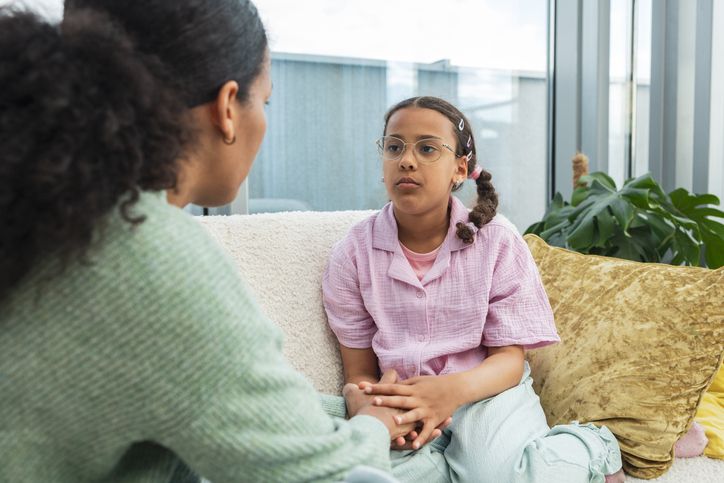
“As a parent, it’s important that you continue to observe your child closely, and I think that we, and I know for me as a parent, I used to think that as your kids got older, well they’re more independent, so then you can start to pull back. But actually, that’s not the case,” said Newsome Duncan. “You have to lean in even more, but in different ways.”
“In my case, my eldest daughter is a talker – she’s a verbal processor – whatever’s on her mind, she is going to speak about it. She doesn’t really hold things inside, so it’s when she goes quiet that I know something’s up. That’s the signal,” she continued. “ The point here is, if you see a difference in your child’s responses and their behaviors, certainly if they’re living at home with you, you are seeing them on a regular basis. Are they spending a lot more time in their room? Do they seem to be putting the phone away when you walk by, which makes you think, wait, what were they looking at? I wouldn’t wait for them to reach out. It is important to reach out now. What that looks like might be, ‘Hey, I just wanted to check in and see how you were doing?’”

“Those things that help to buffer against risk factors,” Newsome Duncan explained. “Just because young people are exposed to a lot of risk factors, particularly these days, doesn’t mean that they will definitely go on to experience an adverse mental health outcome, but as parents and caregivers, we play a huge role in being intentional about using those protective factors, making sure they’re rooted in a sense of cultural belonging and faith or spirituality.”
She continued, “As a parent myself, I felt it was really important that we have tools and materials that parents can also use to support themselves and their own mental health and well-being.”
Click here for to check out The Steve Fund’s Family Corner.
RELATED CONTENT: Why Mental Awareness Is Becoming A New Form Of Self-Care