Why Are Black Women Always Expected To Be Brave?
If That Viral Bernita Bowlding Photo Doesn’t Terrify You, You’re Not Paying Attention To What’s Been Happening To Black Women [Op-Ed]
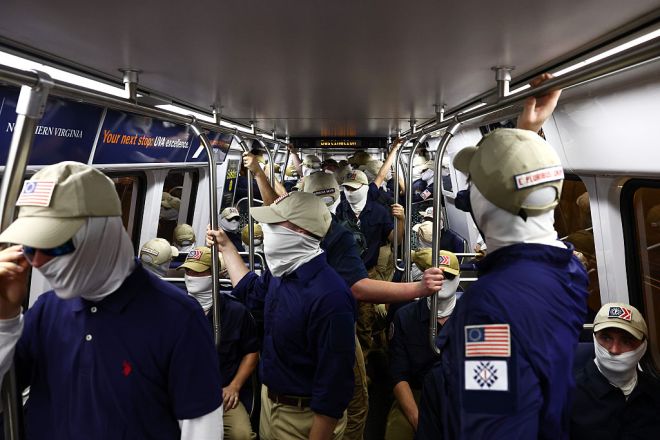
If a picture is worth a thousand words, then a viral photo of a lone Black woman surrounded by members of the white supremacist group Patriot Front, while riding on a Metro train in Washington, D.C., captures the full regressive and divisive scope of America’s current zeitgeist.
The photo was taken by Reuters photographer Cheney Orr on July 4, the 250th anniversary of America’s independence, with several social media users highlighting the juxtaposition between the patriotic holiday and the ironic image, calling it the “defining” picture of the USA today.
Veteran actor Wendell Pierce re-shared the chilling photo on X, writing: “An instant Pulitzer Prize winning photograph.”
RELATED CONTENT: I Have A Nightmare—Martin Luther King Jr. Is Rolling Over In His Grave On Trump’s 2nd Inauguration Day [Op-Ed]

“I feel like the photo of this Black woman surrounded by dozens of masked, anonymous, white nationalists is going to be a defining picture of this moment in America for a long, long time,” commented Melanie D’Arrigo on X.
The woman featured in the trending photo has since been identified as Bernita Bowlding, but she has not publicly commented on her experience. As for the myriad of masked men seen traveling by train and exiting Metro stations in Washington, they joined hundreds of other members of the white nationalist group to march near Capitol Hill, chanting “reclaim America” and “life, liberty, victory” with American and Confederate flags in tow.
Patriot Front was founded in 2017, following the deadly Unite the Right rally in Charlottesville, Virginia, in which KKK members, Neo-Nazis, and alt-right activists marched with tiki torches while spewing racist and antisemitic rhetoric to protest the removal of a Robert E. Lee statue. According to the George Washington University Program on Extremism, the organization endorses an “ultra-nationalist ideology” that is focused on creating a “white ethnostate in the United States,” with the ultimate objective of transforming American society to “align with their vision of racial and cultural homogeneity.”
In other words, if you’re melanated, especially if you’re Black, these are some racist-a– mofos you do not want to find yourself alone with under any circumstances. This is not about acting “scary” it’s about safety. If the recent “mysterious” “drowning” deaths of Stephora Joseph, 11, and Nolan Wells, 18, or the “suicides” of 16-year-old Juliana Nzita and Ashlee Jenae have not taught us anything, let Bowlding’s photo remind us to stay woke. Scratch that, stay wide awake!



There are similar photos of more people of other races and sexes alone amongst Patriot Front members that are circulating online, including one of a young Black man standing in front of the train doors looking on at the sea of coward—err, covert Caucasian men. It is impossible to know exactly what he’s feeling in that moment, in that confined space, swarmed by a group of men too spineless to even expose their eyes. But, based on his dumbfounded facial expression, my guess would be him thinking something along the lines of, “Oh, hell nah! Let me get my Black a– off this train, expeditiously!”

Another image shows a middle-aged white woman sitting on a bench beside a masked man wearing dark sunglasses while she waits on the train platform at the Eastern Market metro station. I wouldn’t say she looks comfortable by any means, but clearly, she feels secure enough to cop a squat beside a Patriot Front member. Albeit, there’s just enough space between her and him for one of his buddies to rest a keg, Confederate flag, or any other staples needed for a long day of racist “protest.”

An image of Roswell Encina, a gay Filipino American civic leader, has also garnered media attention. The president and CEO of the U.S. Capitol Historical Society was traveling by train to an Independence Day party in Maryland. He opened up to Newsweek about his 30-minute train ride, encircled by “a big group of men in masks and hats and sunglasses.”
“I froze. I was really not expecting that,” said Encina, adding, “It was a little unsettling and very uncomfortable.”
“At first, I’m like, ‘Do I try to get off?'” he said, posing a question I’ve wondered if Bowlding contemplated. “And I wasn’t sure who they were either. But it was very unnerving as I started reading what was on their patches,” Encina told Newsweek. which prompted him to secretly search online for the group while still riding the train with them.
He also admitted that he tried his best not to make eye contact with anyone and shared that he found some solace in the presence of Finn Gomez, the Getty Images photographer who caught the snaps, saying, “He added some comfort, knowing that somebody else was there to at least document if anything happened.”
“It’s the Fourth of July, which gives it a bigger, kind of powerful meaning of going through this experience,” concluded the activist. “A moment like this allows you to reflect on the history of the country, especially on the 250th anniversary.”
As a Black woman, the photo of Bernita Bowlding is, without question, the most meaningful.
Since going viral, she is being lauded for her “bravery” with Marlene Gibson, a self-described “Proud Black Democrat. Senoir [stet] citizen” commenting, “She has a Harriet Tubman spirit! She should receive acknowledgement for her stoic position.”
But was Bowlding really exercising effrontery? Unless and until she comments publicly, how are we to really know? Perhaps what we’re seeing is self-preservation, panic, PTSD being triggered in real time, or any number of other reactions that were not obvious or out loud. There are so many emotions and potential scenarios that could have crossed her mind as she waded silently in a sea of disguised white men.
Maybe, like Encina, she did not know who they were or the ideology they represented. Or maybe her “Get Out” radar automatically went into overdrive, and she immediately sensed danger. Regardless, as a woman, especially a Black woman alone amongst a group of racist ultra-conservative white men, the circumstances could have easily turned hostile or life-threatening. Still, as Black women, we are expected to remain composed while navigating misogyny, racism, and public scrutiny, all without the promise of protection from anyone except ourselves. We are constantly praised for being “strong” and “stoic.” But the truth is, sometimes we are just trying to survive by being hypervigilant and discerning, calculating risk, and then regulating our emotions and actions.

Self-protection is something Black women learn long before adulthood. Think of Ruby Bridges, who, at age 6, was the first African American child to attend William Franz Elementary School in New Orleans after Federal courts ordered the desegregation of public schools.
Famous photos taken on November 14, 1960, her first day of class, show a sharply dressed, beautiful little Black girl being escorted to and from school by U.S. Marshals. As the only Black person in the school, the first grader had to walk past police officers and anti-desegregation protesters, some holding signs that read, “All I Want For Christmas is a Clean White School” and “We want segregation.”
Both Bowlding’s and Bridges’ pictures perfectly portray slices of American history and highlight how photographs have revolutionized our ability to document moments in time. But it’s important not to get entirely caught up in the optics or speculate on a stranger’s inner dialogue because no matter how many words a picture is worth, it never tells the whole story. Never.
RELATED CONTENT: ‘Dirty Black Girl’— Drowning Death Of Stephora Joseph, 11, Proves Anti-Haitian Rhetoric & Racism Is Still Rampant In The Dominican Republic [Op-Ed]