How Do We Feel About Black Men Wearing Bonnets?
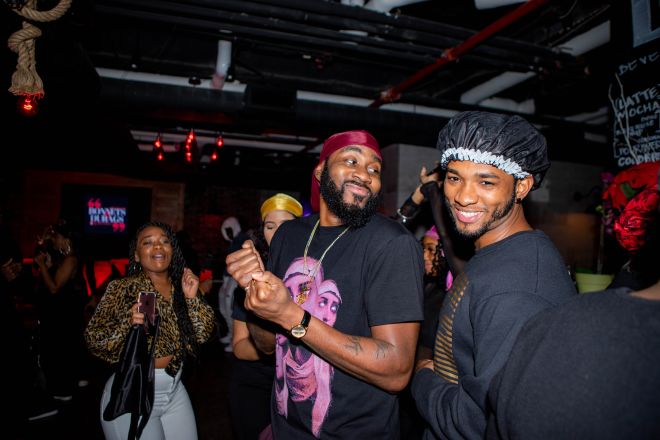
Black women have been catching strays left and right in the bonnet debate for years, but now it looks like Black men have officially been added to the group chat. Yep, the bonnet discourse has expanded. Across social media, some Black men have begun calling out their fellow brothers for wearing bonnets, an item that has historically helped Black women to protect their hair and has become an undeniable symbol of Black beauty culture and self-care.
Here’s the issue: younger generations — especially Black Gen Z and millennial men — don’t seem particularly concerned with those criticisms. Like Black women, they see bonnets as a practical tool: useful for retaining moisture, preserving hairstyles like braids, and protecting locs or natural hair from dust, lint, and friction. For them, it’s less about making a statement and more about keeping their hair together, literally.
RELATED CONTENT: From Baby Hairs To ‘Sticky Bangs’: 5 Times Whiteness Has Columbus’ed Black Women’s Aesthetics
Still, not everyone is on board.
On March 9, content creator Derekius Hawkins shared his frustration, saying he was tired of seeing “way too many” Black men in bonnets.
“Every time I turn around there’s a grown ass man in a bonnet,” he griped in his video.
Hawkins questioned why Black men weren’t sticking to more traditional options like du-rags or wave caps and suggested that bonnets have become more of a trend than a necessity.
“Somebody please tell me what’s the bonnet for?” He added, before implying that it could influence the sons of the men to “grow up gay.”
What sexual identity has to do with a bonnet remains unclear, and frankly, it just sounds downright silly.
DJ Eazy Ice of Charlotte, North Carolina, also weighed in on the topic in 2025, making his stance very clear:
“PLEASE STOP wearing bonnets.”
He argued that bonnets were not designed for men, adding:
“Just because the beauty supply place says ‘Bonnets for Men’, doesn’t mean ‘go get it.’ Women say you look crazy….especially in public!! Don’t shoot the messenger!”
The history of the durag.
Historically, head coverings have always been part of Black male hair care. Black men have worn variations of the bonnet since the 19th century, most notably the durag. Its roots trace back to the United States, with some accounts linking similar styles to 19th-century Ethiopian soldiers, according to NewsOne. Enslaved Africans and later laborers used head coverings to protect their hair from sweat and dirt while working. One of the earliest mentions of the durag before it earned its unique name appeared in the Akron Beacon Journal in June 1966, describing it as “a cloth band worn around the forehead as a sweatband to keep hair in place.”
Over time, the durag became more than just functional. During the Black Power movement of the 1960s and 1970s, it grew into a symbol of pride, identity, and self-expression. The company So Many Waves has said it helped popularize the durag in the late 1970s. Darren Dowdy, its president, told The New York Times that his father, William J. Dowdy, created the garment — originally called the “tie-down” — to help maintain natural hair patterns. It hit the market in 1979 and quickly became a staple.
Here’s why bonnets make more sense for some men.
Durags are still widely used to compress the top of the hair, maintain moisture, and preserve styles like 360 waves, braids, and locs. However, they don’t always protect the full length of the hair, especially the shaft and the ends. Bonnets, on the other hand, offer more coverage, which explains why some men, particularly those with longer hair, have added them to their routine.
MNJ Sales, who sells colorful non-slip bonnets for both men and women online, explained it perfectly in his video shared March 13:
“You can’t protect your hair just with a plain durag.”
Online, some people have questioned why this debate has gained so much attention in the first place.
“Imagine spending your free time, in the state of the world and this economy, worried about how young men protect their hair… these dudes probably bald at that,” one user joked in the comments section of MNJ Sales’ video.
Another user on X penned, “Bonnets don’t have a gender. Bonnets are to protect your hair.”
Content creator and pro-bonnet influencer Zavian Malloy, who shares his haircare process on social media, chimed in on the debate too, hilariously adding:
“Argue with ya mother. Because I’m gonna wear a bonnet every time.”
Spot on!
Who cares!
So what’s wrong with Black men finally taking pride, power, and autonomy over their crown? In other words, whether it’s a durag or a bonnet, the goal is the same: protect the hair. Everything else? That’s just commentary. Let Black men wear their bonnets in peace. Honestly, we’ve got bigger things to be worried about.
RELATED CONTENT: Why Do Black People Wear Bonnets?