'Geriatric Pregnancy' Is On The Rise & Has Never Looked Better [Op-Ed]
‘Geriatric’ Or Not, I’m A Muva — Pregnancy Over Age 40 Is On The Rise & Has Never Looked Better [Op-Ed]
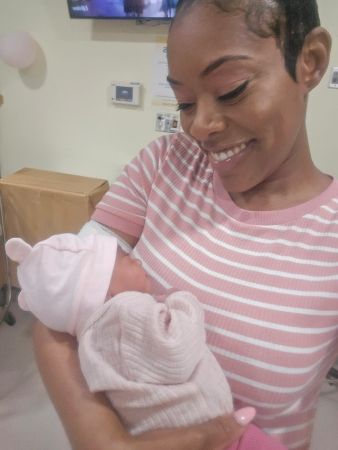
Full transparency: As I attempt to type these words, I’m simultaneously pushing back my keyboard because my 8-month-old daughter is on my lap breastfeeding—well, sort of. She’s also flailing her arms all over, reaching for anything and everything in or out of her sight.
Months seven to eight have easily been my favorite so far—the culmination of so many game-changing milestones—from saying “Da-da” to sitting and crawling to holding her bottle from start to finish of a feeding, often with just one hand. She’s eating more actual “food” (mostly purees), so that she’s much less dependent on that expensive-ass (albeit, life-saving!) formula and my breast milk.
Combined with her sleeping through the night, I’ve finally regained some level of sanity, flexibility, and solitude, which had been completely absent from my life since she was born, especially during the early months when she was solely breastfed. Now, I have the luxury of breastfeeding not only for her literal survival but also for comfort or to put her to sleep, which is what I’m trying to do while I write.
RELATED CONTENT: 10 Black Women Who Gave Birth After 40, Proving It’s Never Too Late
But my daughter suffers from severe FOMO (fear of missing out), and always has. So, she’s doing what my sister dubbed “the Stevie Wonder,” swinging her head back and forth, trying her damndest to fight the sleep while also rigorously rubbing her spellbinding, almond-shaped, slanted eyes, which I have no shame in bragging that she got from me! She looks up at me as if she’s asking for my blessing to fall asleep. As a sign of reassurance, I kiss her forehead and hold her tight. Now she’s wrapped around me like a baby koala bear, the touch of her fingers like silk filled with love.
I’m trying to type as lightly and with as little motion as possible so that I don’t wake her up. Now she’s “slaughing” a portmanteau my 10-year-old goddaughter came up with for when she smiles in her sleep, which she does often, and shows off her one dimple on her left cheek. Yeah, she got that from her Mama, too! She’s my “dimple twin,” just one of a never-ending list of nicknames starting with “Kickie Monster” to “Stinkerdoodle” to “Smiley Bear.” She’s a happy baby. Very happy. Always has been. Sweet. Loving. Beautiful. Smart. Healthy. Perfect.
I have never felt as purposeful as I do being her mother. So, if having my daughter and becoming a first-time mom after 40 makes me “geriatric,” I’ll be that forever and a day.
Not Experiencing Motherhood Was My Only FOMO

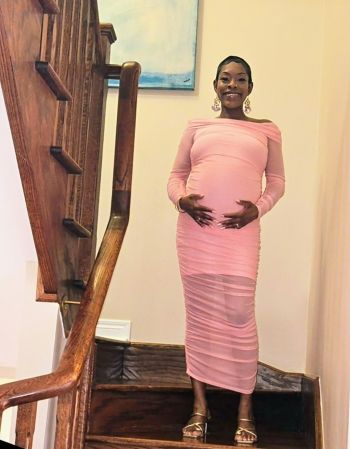
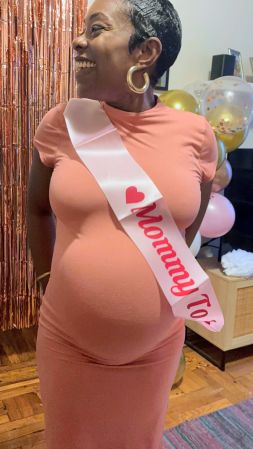
I am a first-time mom who returned from maternity leave to my full-time remote job as Senior Editor at MadameNoire just over a month ago, and I represent a growing number of women who are having babies later in life, more than ever in fact.
An August 2025 survey from HRC Fertility revealed many people think the term “geriatric pregnancy”—defined as pregnancy at age 35 or older— is antiquated and may even exacerbate anxiety for women 35 and over who want to get pregnant. It’s well-known that stress during pregnancy can have detrimental outcomes on both the mother and the unborn child. As Dr. Sasha Hakman explained to Parents, “Pregnancy anxiety or stress is associated with earlier delivery and higher preterm risk,” regardless of age.
Honestly, the label and the idea of being pregnant after 40 really did not concern me. I’m comfortable and confident in my “big age,” as the kids say now. I just knew I wanted to be a mom. Motherhood has always been something I’ve wanted and believed was in my destiny. And, not becoming one sooner was a very conscious and personal decision I made based on various factors, like choosing the right partner.

Another reason was the February 2023 death of a close friend of mine, who passed away suddenly at age 39 from pregnancy complications due to fibroids. Like many, correction, most Black females, I have uterine fibroids. I have been fortunate enough to know about mine since I was in high school, and they have never caused me any serious issues besides the annoyance of heavy and long periods.
Varying in number and size, Mayo Clinic describes uterine fibroids, also called leiomyomas (lie-o-my-O-muhs) or myomas, as common growths of the uterus that “often appear during the years you’re usually able to get pregnant and give birth. Uterine fibroids are not cancer, and they almost never turn into cancer. They aren’t linked with a higher risk of other types of cancer in the uterus either.”
Still, based on the loss of my friend, combined with the staggering maternal health statistics for Black women, and let’s not forget my age, I did my due diligence beforehand to ensure that my fibroids would not interfere with my journey to motherhood.
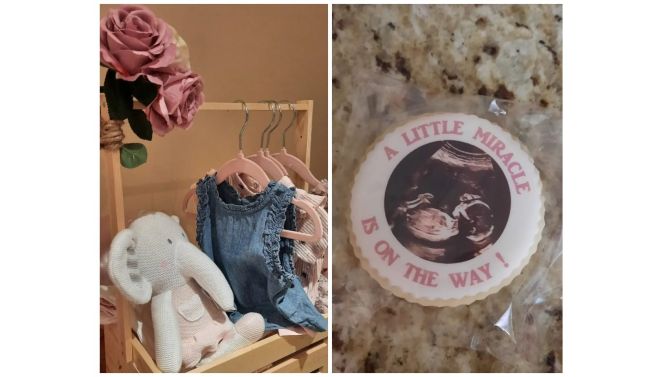
To get a more thorough assessment and understanding of my fibroids, in May 2023, I underwent both a transabdominal and a transvaginal pelvic sonogram, an “exam that produces images that are used to assess organs and structures within the female pelvis.” During the procedure, digital images of my fibroids were taken, and they were also measured.
The sonogram results found “several intramural fibroids measuring up to 6.3 cm,” but nothing that was concerning or that would hinder my ability to conceive, carry, or deliver. I am truly blessed and grateful that there were no issues at any stage of my pregnancy due to my fibroids, age, or any other reasons.
According to Mayo Clinic, people of African descent are disproportionately affected by uterine fibroids, with up to 90% having developed fibroids by age 50. Furthermore, Black people develop fibroids at younger ages and have larger, faster-growing fibroids.
Despite my self-assuredness and good fortune, I was and am still very aware of how age can negatively impact conception and complicate pregnancy, especially for Black women. The reality is that there are increased risks for those who get pregnant over age 35.
So, let’s discuss this thing called “geriatric pregnancy.”
RELATED CONTENT: Mompreneurs: Demystifying Fibroids And Fertility With Gessie Thompson
Age Ain’t Nothing But A Number, But Not When It Comes To Fertility, Pregnancy, And Delivery

It was Oscar-winning actress Halle Berry who introduced me to the term “geriatric pregnancy.” While pregnant with her daughter, Nahla Ariela Aubry, in 2008, the then-41-year-old posed for the February issue of InStyle magazine, in which she shared, “Did you know this is a ‘geriatric pregnancy?’ I cringe when I hear that. I’m like, ‘Take that off my chart!’”
“This unfortunate term is thought to stem from a concept that dates back to the 1970s, when amniocentesis, a procedure to screen for genetic abnormalities, was becoming routine,” wrote science journalist Rachel E. Gross in a 2023 article for The Atlantic titled, “Please Don’t Call My Cervix Incompetent.” She explained, “That year, the National Institutes of Health identified 35 as the age at which the risk that the test would harm the fetus was roughly equal to the chance of a fetus being born with Down syndrome.”
Firstly, the term “geriatric pregnancy” is now considered offensive and outdated. Now, the preferred term for people who become pregnant at age 35 or older is Advanced Maternal Age (AMA). According to Johns Hopkins Medicine, “the majority of healthy people who get pregnant in their late 30s, and even into their early 40s, have healthy babies.” Still, “age is one of the most important” fertility factors.
Some risks of AMA pregnancies include hypertension, gestational diabetes, preeclampsia, and chromosomal abnormalities. A decline in fertility, sometimes related to fibroids or endometriosis are also more likely for older people. “There’s also a slightly increased risk of stillbirth for moms-to-be over 40,” explained Dr. Hakman.
The risk of miscarriage also increases with age, with experts estimating that 50–75% of pregnancies can end in miscarriage after age 40. However, Dr. Hakman and most experts agree that “most pregnancies after 40 are healthy and fairly uncomplicated, assuming there’s no prior medical history.”
According to OB-GYN Dr. Natasha Spencer, “A healthy pregnancy after 40 is highly dependent on the individual health of the person. Someone who is generally healthy could have an uncomplicated pregnancy with a good outcome.”
Do The Education, So You Can Make The Right Decision

Due to my age and my preexisting high blood pressure, not only was I considered “geriatric,” but I also had to be treated by an OB-GYN who also specialized in “high-risk” pregnancies. This meant that a few times during my pregnancy, my blood pressure medication had to be changed or the dosage tweaked. But my numbers were always good, and my blood pressure remained well-managed.
I was also required to see my OB-GYN more often than usual. Lastly, I underwent extensive prenatal screening and diagnostics (such as cell-free DNA) or diagnostic genetic testing (such as chorionic villus or amniocentesis), which are extremely helpful in providing important information about the genetics of the developing baby. Some of the tests were recommended by my team, and others were optional, but I decided to err on the side of caution and do them all. While some can be a bit physically uncomfortable and invasive, mostly, they are mentally and emotionally stressful. But, the results offer a comforting level of reassurance or options. As my amazing OB-GYN, Dr. Kilanko, says, “You do the education, so you can make the right decision.”
Although IVF accounts for only around 2% of births in America, it’s also another driving factor in the rise of older single mothers in the U.S. NPR recently explored this phenomenon in an article titled, “How IVF has led to a record number of single moms in their 40s.” A whopping 44% of women in America are currently unpartnered, and at the same time, the country’s overall birth rate is declining.
“The number of unmarried women in their 40s who are having babies has grown by 250% in the last 30 years, according to data from the government,” wrote Pallavi Gogoi and Janet W. Lee. “A portion of these women have partners, but many don’t.”
I did not experience any difficulties or delays in getting pregnant. But for women with fertility issues, who don’t have a partner, or who simply want to give themselves options, IVF is a solid alternative. I personally know of two women who froze their eggs last year. One is in her early 40s, and the other was 35 at the time. Both Black. Both single. Both still hopeful to find love and conceive naturally. But, both also realistic and forward-thinking enough to understand that these dating streets are disturbingly dusty.
Of course, everyone’s experience is unique. But for me, “geriatric pregnancy” looked a little like this: never-ending lower back pain, narcoleptic-level sleepiness, occasional lightning crotch, and my daughter’s nonstop kicking, which she still does to this day; hence, the nickname Kickie Monster. At night, I experienced debilitating leg spasms and teeth grinding so severe that it often woke me and others up because it sounded like I was “chewing on rocks!” I’ve heard too many stories about women who lost teeth during pregnancy, so I got myself a nightguard ASAP.
But on the flip side, shockingly, I never vomited! My skin was blemish-free and glowing from head to toe for all nine months. Literally, the best skin I’ve had since … EVER! Granted, I was perpetually greased up with a combination of everything included in Palmer’s Complete Stretch Mark Care Kit, in addition to Jamaican castor and coconut oil—the real stuff sold by the rasta man dem in yaad gifted to me from one of my grandmother’s years ago. I was always covered in pretty much anything you can use to fry food! Hey, I didn’t get any stretch marks on my stomach or any new ones elsewhere on my body, so mission accomplished.
Honestly, for me, the real mission has always been motherhood and her, my beautiful baby girl. “Geriatric” or not, I’m a muva. Hers.

RELATED CONTENT: Reducing Stress Levels During Pregnancy Is Crucial For Black Women, Here’s Why