Meet The OB-GYN Black Women Call 'The Fibroid Slayer'
‘I Can Save Your Uterus’ — Meet The OB-GYN Black Women Call ‘The Fibroid Slayer’ [Exclusive]

For generations, Black women have shared a silent, agonizing bond. It is the heavy burden of uterine fibroids. Statistically, the numbers are staggering: benign muscular tumors develop in up to 80% of Black women by age 50. Yet, despite how pervasive this condition is, the medical establishment has routinely offered a devastatingly narrow script to those suffering: normalize the excruciating pain, live with the heavy bleeding, or undergo a hysterectomy. Dr. Pierre Johnson is actively tearing up that script.
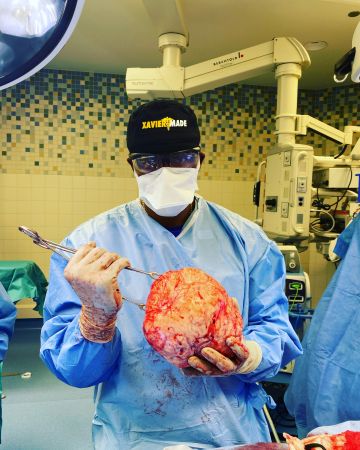
A board-certified OB/GYN specializing in minimally invasive surgery and pelvic floor repair, Dr. Johnson has built a fierce national reputation for managing some of the most complex, advanced fibroid cases in the country. His patients—many of whom discover him through his modern, open-window approach on social media—have affectionately dubbed him “The Fibroid Slayer.”
Dr. Johnson recently made national headlines by executing a near-miraculous procedure: removing a massive, 27-pound fibroid from a pregnant woman who had been told by other physicians to terminate her pregnancy and undergo an immediate hysterectomy.
MadameNoire sat down with Dr. Johnson for Fibroid Awareness Month to discuss this case, the deep-seated systemic inequities that leave Black women underserved, and why he firmly believes that no fibroid is ever too big to manage.
RELATED CONTENT: ‘I Do Not Have A Uterus’—Over 600 Sue Hospital After OB-GYN Performed Unnecessary C-Sections And Hysterectomies On Mostly Black Women
Dismantling Conventional Limits
To understand why Dr. Johnson is a disruptor in modern gynecology, we have to consider the rigid, often unquestioned guidelines that govern standard surgical training. When faced with advanced fibroid disease—uteruses stretched to the size of full-term pregnancies—many surgeons instinctively default to major open abdominal surgeries or complete uterine removal. They treat the organ as disposable, ignoring the patient’s bodily autonomy and future maternal desires. Dr. Johnson rejected that limitation early in his medical journey.
“At the end of the day, it’s a benign tumor. You know, it’s 99.9% benign. These are not cancerous things that you’re dealing with. So, it really comes down to the compassion and the willingness to do the things necessary to give someone the opportunity for pregnancy in the future or to have a minimally invasive approach to remove a problem that they didn’t ask for.” For him, the solution wasn’t to change the patient, but to evolve the technique.
“When I graduated residency, I just had the mindset of ‘There’s not a fibroid that’s gonna be too big that I can’t deal with. I’m not gonna turn down any case, no matter what case ever comes.’ You should be able to remove it, and not only remove it, you should be able to do it in a minimally invasive way. I just started to figure out different methods and different ways to make my belief true.”
The Intersection of Bias, Inequity, and Lack of Empathy
Medical charts can measure the diameter of a tumor, but they fail to capture the cultural and economic battlefields Black women navigate. Dr. Johnson shared that the disproportionate impact of fibroids on Black women cannot be divorced from institutional bias and societal realities.
“Across the board, there’s a lack of representation in all professional realms… And so to that point, there’s also a lack of empathy, a lack of going the extra mile for people, a lack of relatability. You have implicit biases that you don’t even pay attention to. We all do, but when in medicine, it becomes problematic because you’re now dealing with people’s lives.”
He connects these modern clinical biases directly to the socioeconomic trajectories of Black women over the last several decades, noting how many have focused on education and careers, putting family off until later in life. When these accomplished, professional Black women finally enter medical offices in their late 30s or early 40s ready to conceive, they are frequently met with a chilling lack of cultural awareness.
“When they get to these providers, their thought process is ‘you’re 40, or you’re 38, or you’re 41, you’re 42. It’s too late for you to have babies.’ The empathy of understanding the cultural impact of how we’re at a disadvantage socially doesn’t play in so much as it comes to medical decision-making.”
The result is a dangerous trend of medical dismissiveness where a woman’s reproductive goals are treated as secondary or irrelevant.
“There’s so many doctors that are very dismissive of women. ‘If you have fibroids, just remove your uterus.’ Not asking them what their goals are, not asking them what their pathway may be. Not educating them on their pathway because their own bias of, ‘Well, that’s not important,’ or, ‘You don’t need that,’ comes into play.”
Compounding this cultural disconnect is a severe technical deficit within the medical community. Many providers simply lack the advanced training required to handle severe cases laparoscopically.
“Too often I hear women and they’ll say, ‘Well, they told me the only [option] I had was a hysterectomy,’ or, ‘The only option I have was a vertical incision.’ That’s them speaking to the limits of their abilities as opposed to speaking to the possibilities… If a Black woman goes to two or three doctors and she just hears, ‘Hysterectomy, hysterectomy,’ she’s gonna continue to run. That time where she waits, things can grow and get even more advanced.”
RELATED CONTENT: ‘This Is Not Rare’ — Lupita Nyong’o Shares Shocking 77-Fibroid Diagnosis
Changing the Narrative: A Protocol of Trust and Truth
When a patient finally makes it to Dr. Johnson’s office, the clinical environment shifts from an adversarial space to a collaborative, deeply validating sanctuary.
“First of all, I tell them [they’re] talking to somebodywho understands the cultural context of what hysterectomy means…somebody that has empathy for your situation. Then I tell them, ‘Totally erase and eliminate anything that you’ve already heard. I don’t care what your situation is, I can save your uterus. That’s not the problem. The problem is what are your goals and what are you trying to achieve?”
Instead of obsessing purely over the tumors, Dr. Johnson pivots the medical strategy to focus on the unforgiving reality of a woman’s biological clock: the ovaries.
“The only aspect of pregnancy that has a timetable associated with it are eggs…your ovaries. You could have a perfect uterus, but at a certain juncture, you will lose the ability for pregnancy. The misconception is that the decrease [in eggs] is always predictable. It’s a false assumption that they impose on themselves. We have to start talking about what it is that you need to do to get to the optimal goal of pregnancy.”
Anatomy of a Miracle: Inside the 27-Pound Case
The culmination of Dr. Johnson’s approach is exemplified by his recent case involving a distant relative of his own family who was facing an unimaginable maternal crisis. He received a call from a cousin explaining that her niece was pregnant, had a massive fibroid, and was being told to terminate the pregnancy.
The true gravity of the situation only hit him once the patient arrived at his clinic. The sheer mass defied standard diagnostic equipment.
“When I laid eyes on her and saw the ultrasound, I couldn’t measure the size of her fibroid because it was so large. I had to actually see her to see it for myself and say, ‘Okay, we are dealing with something different.’ When I talked to her, [I said], ‘I can do this. It’s gonna be risky, but I know I could do it, no question. Not only can I do it, I could do it in the exact same way as I do everybody else’s. We don’t have to do vertical incision.'”
Behind his calm demeanor, Dr. Johnson’s sharp intellect was actively solving a complex puzzle under extreme pressure.
“I knew that when you have a mass that big, it’s not really intrinsically embedded in the uterus. It’s typically [stalked off] of the uterus… I figured [this is what it] was going to be. I knew it really had to be that because if she actually achieved pregnancy, [the fibroid] could not significantly be involved with the uterus. She would’ve had a problem with getting pregnant.”
With the clinical roadmap laid out, the patient placed her trust completely in his hands. In the operating room, his surgical intuition proved correct.
“I made the incision and it was pretty much exactly what I thought. It was a huge stalked off fibroid, but it was bigger than I’d ever seen… The key was to get to the stalk of it. Once I was able to get to the stalk of it, that’s like cutting the head off a giant. Once I was able to do that, it’s just getting it out, which I could… That’s easy.”
The dramatic growth of the tumor was fueled directly by the hormonal shifts of pregnancy itself.
“She had a pretty large fibroid before, but it was nothing like that. It morphed like that because of the high estrogen in the state of pregnancy. In pregnancy you [have about] double the volume of estrogen, and that’s what fibroids feed off of… Hers just went into overdrive with estrogen.”
Listen to Your Body
While headline-grabbing surgeries highlight the extreme edge of advanced fibroid disease, Dr. Johnson is equally dedicated to educating the everyday woman on how to accurately evaluate her body without living in a constant state of hyper-vigilance or anxiety.
“The biggest thing is don’t concern yourself so much with ‘do I have fibroids?’ Fibroids in and of themselves are not necessarily a problem. It’s size and location… I tell more women that they don’t need surgery than I [tell them that they] do. So it’s not to say, ‘Go get an ultrasound. Go get an MRI. Just figure out if you got fibroids so you know.’ That’s just setting you up for consistent worry and stuff.”
Instead of hunting for fibroids via imaging, Dr. Johnson outlines the clinical shifts that warrant a visit to a trusted practitioner:
- Changes in Bleeding Patterns: “Listen to your body. Pay very close attention to your body and changes in your body. If you had a consistent bleeding pattern in your life, now all of a sudden it’s just super heavy and increasingly starting to get heavier, that’s something to have a conversation about with your doctor.”
- Abdominal Changes and Noticeable Masses: “If you didn’t feel any masses or anything before, and now when you press on your belly you feel hard–whether it’s during your period or not–but you start to feel differently in your belly as you press in your belly, that’s absolutely something that alerts to say, ‘Hey, let me go see and let me go figure it out.'”
- Painful Intercourse: “If sex used to always be pleasurable, and now all of a sudden sex is painful and uncomfortable–whether [it’s] cramping or during the act itself starting to have pain, that’s definitely something to have seen.”
- New Onset Menstrual Pain: “If your periods were just regular but now they’re excruciating pain or now you have a new onset of pain during your periods, that’s another reason, too.”
- Unexplained Infertility: “If you’re actively trying to get pregnant and pregnancy is just not happening…you’ve done all of the things–ovulation predictor kits, semen analysis, and all of the preliminary things–that’s something that alerts you to go to your doctor.”
Ultimately, the standard for reproductive preventative care remains a rigorous, hands-on physical evaluation by a professional who listens.
“If you have regular periods, no pain, pleasurable sex, you’re not having any issues whatsoever, don’t go to your doctor to say, ‘I want an ultrasound to see if I got fibroids.’ Don’t do that, but your doctor should be–in addition to your regular annual exams– doing a digital exam where they’re actually feeling your uterus, feeling your ovaries to make sure that there are no large masses or anything to be of concern.”
Through clinical brilliance, cultural advocacy, and an unwavering commitment to preserving Black maternal health, “The Fibroid Slayer” is proving to Black women everywhere that our bodies, our families, and our futures are worth fighting for.
RELATED CONTENT: Fibroids Are Not Just A ‘Black Woman’s Disease’: Advocates Push Congress To Finally Take Benign Tumors Seriously