The DNA Discovery That Turned Father's Day Into An Identity Crisis
‘Your Daddy Ain’t Your Daddy!’ — How Learning I Had Three Fathers Turned Father’s Day Into An Identity Crisis [Op-Ed]
An email notification from AncestryDNA arrived with the quiet thud of an unexpected inheritance, carrying a message that would forever alter the story of my life. For weeks, my intuition had whispered to me that something was off, a lingering gut feeling that only deepened as my processing results went through lengthy delays. When the screen finally showed me a list of unknown close relatives in my DNA matches, the truth revealed itself as a total restructuring of my identity.
I was staring at a Non-Paternity Event, or an NPE—a clinical, sterile acronym that fails entirely to capture the psychological disorientation of realizing the man whom you thought was responsible for your skin tone and demeanor is not your biological father. In that transformative moment, my understanding of my own ethnicity, my ancestral lineage, and the very concept of kinship fractured, plunging me headfirst into an adult identity crisis that demanded I reconstruct the meaning of family from the ground up.
The emotional fallout was an immediate, overwhelming storm of shock, frustration, and deep-seated anger, born from the painful realization that such a truth had been in the shaadows for three decades. As the eldest sibling in a household where adoption was an openly discussed and embraced reality, I believed I possessed a sophisticated, mature understanding of non-traditional family structures; yet, applying that framework to my own self felt entirely different. It is a unique kind of vulnerability to realize that you are the keeper of a secret you were never intended to know, balancing the preservation of maternal dignity against your own hunger for clarity.
Within the experience of Black womanhood, this particular revelation carries a distinct, heavy cultural stigma, frequently weaponized by a society eager to reduce our intricate family stories into reductive caricatures of brokenness. “Your daddy ain’t your daddy” ceases to be an abstract cultural trope or a punchline, transforming instead into a sharp, intimate mirror that forces a woman to reexamine every mirror reflection, every curl of her hair, and every foundational memory she holds dear.
RELATED CONTENT: African Ancestry’s Dr. Gina Page On The Importance Of Black People Discovering Their Roots
The Father Who Raised Me
To make sense of having three fathers, I have to look at the exact space each man holds in my life. It makes sense to start with the one who earned the title by always showing up. I am an absolute, unapologetic Daddy’s girl. The man I call my father has been a huge part of my world for as long as I can remember. I was only in the first grade when I found out he wasn’t my biological dad, but that didn’t matter. It couldn’t compete with the daily reality of his love.
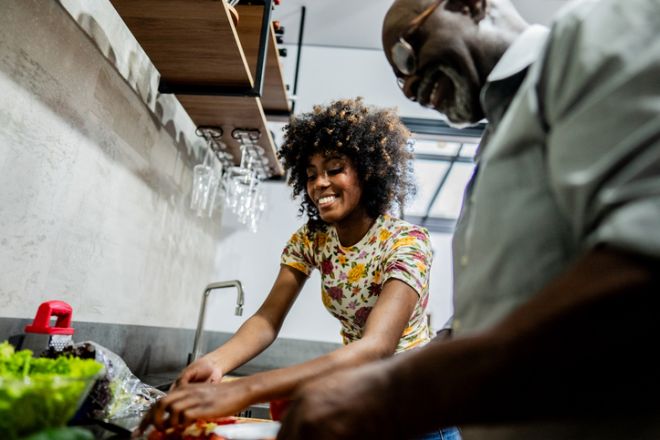
He is the only real father I’ve ever known, the one who was there for every milestone. He’s the man who patiently taught me how to count money and time, sat across from me at the table teaching me dominoes, and had a special kind of kitchen magic that could make a standard boxed cake taste like it came from a high-end bakery. He even baked the cakes for many of my birthdays. His friends are all my uncles. We share an understanding that has kept us close through all the typical growing pains of having an adult child.
The Father of My History
The second father in this story is the man I spent about twenty five years believing was my biological dad. Our relationship was defined by long-distance longing, missed moments, and a deep cultural inheritance. For most of my youth, our bond was shaped by his incarceration. Our connection was a mix of letters, occasional visits to the deep south, and random moments of actually getting to see each other. Once he was out, I’d try to bridge the gap from my home in Maryland. As I became an adult, the sting of rejection annoyed me too much to push for a relationship anymore.
Before the DNA test changed everything, I was actively trying to heal from the hurt of him not being there during my fluid, formative years. More than the missed events, it was his evasion that stung. He completely avoided any honest conversations about the state of our relationship. Eventually, he decided it was just too late to build a real bond with me and stopped trying, leaving me with a relationship that felt like an unfinished puzzle.
Yet, finding out he wasn’t my biological father didn’t erase him from who I am. Instead, it shed a new light on the massive family network the relationship left behind. For three decades, I was raised as a Jamaican American, deeply wrapped in the traditions of his mother and brother (along with my dad, who is also Jamaican), who always reached out to build genuine bonds with me. Believing I shared his blood meant believing I was the eldest of a bunch of siblings in New York and Virginia. Learning the truth meant realizing I actually only have one biological sibling on my maternal side. Of course, relationships with your brothers and sisters don’t end as fast as this revelation hit me. However, it changes things. To this day, I haven’t exactly figured out how to exist in this family anymore. I know wholeheartedly that the love didn’t change, but there’s a great deal of awkwardness and awareness that makes it hard to come around.
Processing everything also means recognizing that those experiences were still meant for me. DNA can’t wipe away the sensory memory of what fresh ackee and saltfish smells like on a warm morning, or tear down the cultural bridge of my childhood. I’ll always carry the joy of my maternal cousin teaching me to pop to the sounds of “Funky Y2C,” right alongside memories of my Jamaican cousins teaching me how to whine to Beenie Man in Brooklyn. My grandmother and that whole village fiercely protected me, making sure their baby girl was cultured and saw New York through the eyes of a young lady with places to go. That history shaped how I carry myself, how I view the world, and my creative spirit. I’ll always be grateful for a heritage that was technically borrowed but completely lived.
RELATED CONTENT: Congrats, Big Mama! Latto Welcomes Her 1st Child & Finally Confirms 21 Savage Is Her Baby Daddy
The Legacy of the Secret
An NPE carries a unique, heavy stigma for Black women, and standard genealogy spaces rarely talk about it with the right cultural nuance. In mainstream culture, people love to weaponize this reality against us. It’s used as a cheap punchline that reinforces harmful stereotypes about Black mothers and broken families. This public mockery creates a deep shame that forces a lot of Black women to carry these secrets in absolute isolation.
To understand how this hits a Black consciousness, you have to look at the brilliant ways Black people have always defined family outside of traditional Western boxes. For generations, dating back to slavery when biological families were intentionally torn apart at the auction block, our people have had to master the art of chosen family. We have a rich history of people stepping up to build a village out of survival, whether it was due to the Great Migration where parents went North to send for their kids later, or the devastating impacts of the Black maternal health crisis, the crack epidemic, and the war on drugs.
Today, Black millennials have taken that ancestral survival tactic and turned it into an intentional culture. We look at our college roommates and our friend circles, instantly labeling them as the favorite aunties and uncles for our kids. We’ve always understood that blood is secondary to safety and love. We build our families out of real commitment, expanding our borders so no child has to navigate the world without a protective ecosystem.
The Ordinary and the Extraordinary
The reality of my paternity hits close to home for me every day now as I watch my partner with his preschool-aged daughter. Watching their relationship has opened my eyes to an everyday fatherly closeness that I never experienced biologically. There is a quiet assurance in being able to look at your dad and see your smile reflected back, or knowing your shade of brown hair is identical to his. These ordinary moments feel like a miracle when you’ve spent your whole life without them. They’re a gentle reminder of the missing pieces in my own story.
The weight of that generational gap became incredibly clear to me recently when I learned that my biological grandmother passed away. I didn’t even know she was still alive until the news of her death reached me. I made the painful choice not to attend her funeral. My complete lack of a relationship couldn’t justify the emotional and financial drain of traveling down to Alabama. I couldn’t bring myself to stand in a room full of strangers, watching them look at my face and comment on how much I looked like a woman I never got to know.
The emotional math of that situation was just too heavy. It forced me to mourn the uncomplicated childhood I might have had if I’d been given the traditional experience of a biological father. Yet, even in that grief, I know my identity is a beautiful mosaic. Without the complex journey of my three fathers, I wouldn’t have the rich village that made me the woman I am today.
If Father’s Day is complicated for you, I hope you give yourself permission to stop trying to force the day into something it isn’t. Not everyone arrives at this holiday carrying uncomplicated gratitude. Some of us are grieving fathers we’ve lost. Some of us are grieving fathers we never had. Some of us are still trying to make sense of the men who shaped us, disappointed us, loved us, or left questions behind. This year, my plan is simple. I’ll celebrate who I can. I’ll call my dad, the man who raised me. I’ll celebrate the good fathers in my life who continue to show up for their children and their communities. I’ll probably spend some time journaling, making room for the feelings that don’t fit neatly inside a greeting card. If your Father’s Day feels anything like mine, maybe that’s enough. Maybe the goal isn’t to have all the answers or to resolve every complicated feeling. Maybe the goal is simply to honor the truth of your experience, make peace with what you know, and extend a little grace to yourself for what you still don’t.
RELATED CONTENT: ‘Still Your Only Girl’ — Monica Mourns The Death Of Her Father, M.C. Arnold Jr.