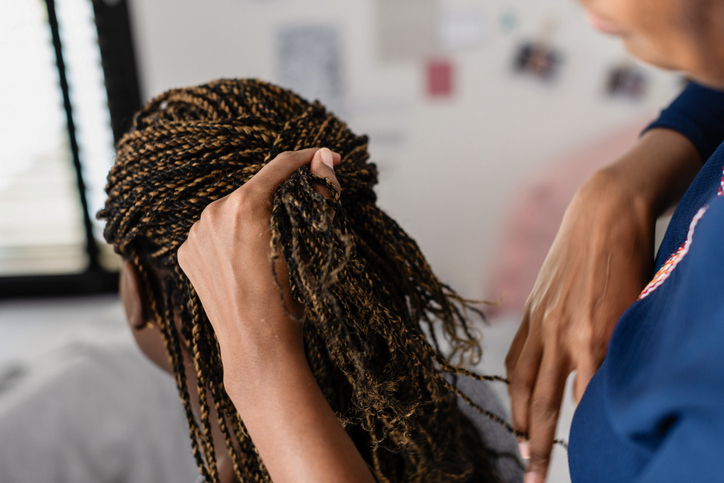
If you have ever left a braiding salon with your edges pulled so tight you could not fully close your eyes, or gone home with a scalp so irritated you spent the first three nights of a fresh install wincing every time your head touched a pillow, you already know the experience this story is about. There’s a quiet gaslighting happening within the Black Beauty industry and an interesting reason we continued to sit through it.
If you ever mentioned that pain to the person sitting next to you in the chair, chances are she looked at you and said some version of the same thing we have all heard:
“Girl, beauty is pain. You will get used to it.”
We accepted that. For years, most of us just accepted the thought that we had to endure some level of pain to look beautiful.
The itching, the redness, the bumps along the hairline, the scabs that showed up by day two of a fresh set of braids, we treated all of it as an unavoidable tax on wearing our hair the way our culture has worn it for generations. Nobody in the beauty industry was asking why. Nobody was suggesting that the problem might not be our scalps, but what was being put on them. The message delivered to Black women — quietly and consistently — was that discomfort was simply part of the process.
“Keep your head still.”
“Stop being tender-headed.”
“It will be worth it when it is done.”
That is not beauty culture. That is gaslighting with a rattail comb and some grease.
Essence recently shared a story about the Black beauty brand, SLAYYY Hair. In early 2025, Consumer Reports published a first-of-its-kind investigation into synthetic braided hair, in which they tested 10 of the most popular products on the market. The study found that toxic heavy metals and carcinogens were in nearly all of them — including lead, benzene and methylene chloride. All of these are linked to serious long-term health consequences, including cancer and reproductive harm.
Read that again. The hair that millions of Black women have been sitting under for hours at a time, in salons, on kitchen floors, in dorm rooms, at kitchen tables across generations, has contained toxic heavy metals and carcinogens linked to cancer. And the industry response for decades was to tell us to soak it in apple cider vinegar and manage our expectations.
Nearly 72 percent of Black women wear some type of hair extension at least once a year, and protective styles are often worn for weeks at a time, meaning the exposure is not a single event. This was not an occasional inconvenience. For many of us, this was chronic, repeated contact with materials never designed with our health in mind — within an industry that has taken billions of our dollars while treating our comfort as an afterthought. Tuh!
The cultural conditioning around this is something to explore. From the time many of us were little girls sitting between our mothers’ knees, we were taught that getting our hair done meant suffering. That a tight scalp meant the style would last. That itching was normal. Those bleeding edges were the price of long-lasting box braids. We carried those lessons into adulthood and passed them to each other in salon chairs the same way they were passed to us. It was not out of malice, but because none of us had ever been given a reason to question them.
Founder of SLAYYY Hair, Diann Valentine, put it plainly when she said, “We didn’t need to recreate the wheel, but we needed to answer the call of Black women who are suffering in silence at the hands of just trying to wear a protective style or a cultural style that is truly native to who we are.”
Suffering in silence. Those three words are the entire story. We were not dramatic. We were not tender-headed. We were being harmed and the industry we trusted with our crowns spent decades telling us to be quieter about it.
The conversation is shifting now, slowly but meaningfully. But the first step in that shift is being willing to say out loud what many of us have known in our bodies for a long time.
The pain was never normal. We just never had anyone tell us we deserved better. Well, Black women deserve better. We said it.