For as long as many of us can remember, people have been fascinated by the friendships Black women share with one another. Some of that fascination may be rooted in admiration. Some of it may even be envy. But a great deal of it comes from people struggling to understand the depth of our relationships. And we all know what tends to happen when people do not understand something: they create a false narrative and then act like it is the truth.
When two Black women are deeply connected, when they travel together, talk every day, finish each other’s sentences, know and love each other’s children, share holidays, show up during heartbreaks, and celebrate one another’s victories, someone inevitably asks the question, “Are they together?” Or make the statement, “Something ELSE is going on with them!”
This tired and ignorant assumption has followed women like Oprah Winfrey and Gayle King for decades. Never mind that both women have repeatedly explained that their relationship is rooted in love, loyalty, trust, and sisterhood. People continue searching for an explanation they can make sense of because two women cannot simply love each other deeply without somebody trying to make it sexual.
Instead of minding the business that pays them, folks pick apart every detail of their lives and insist there must be something more there. Because to them, they cannot just be friends. They must be lovers.
But my question is: why? Why is it so hard for society to believe that Black women can simply love each other? Not romantically. Not sexually. Just deeply.
You know, the way sisters care for one another when they have been a constant source of love, light, joy, and peace. The very things Black women crave and deserve. The things we often do not receive enough of in romantic relationships, workplaces, healthcare systems, or even in the world at large. The things we need when relationships fail, jobs get stressful, children start acting like they pay bills, and life starts lifing a little too loudly.
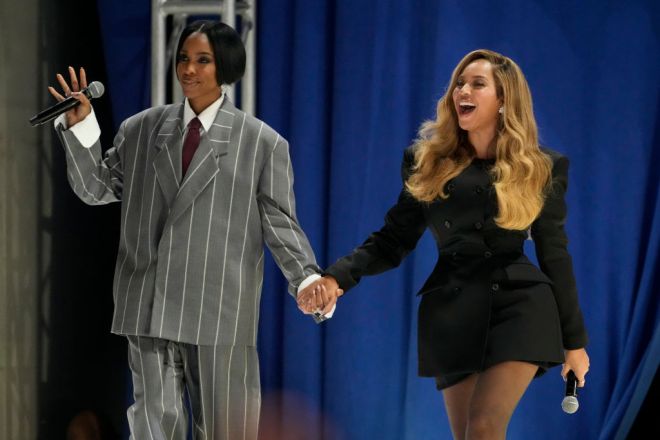
And Oprah and Gayle are not the only examples of Black women whose friendships have been publicly examined, celebrated, or misunderstood. We have watched Beyoncé and Kelly Rowland love each other from girlhood to global superstardom, with a bond that is obviously a sisterhood and an industry friendship. We have seen Queen Latifah and Jada Pinkett Smith carry a friendship that predates their iconic work together and reminds us that some bonds grow alongside careers, marriages, children, reinvention, and womanhood itself.
Mary J. Blige and Taraji P. Henson have shown us what it looks like when two powerful Black women admire, affirm, and pour into each other publicly. Tisha Campbell and Tichina Arnold gave us friendship on-screen through Martin, but their real-life bond has long outlived the sitcom set.
These women remind us that Black women’s friendships are not performative. They are not always cute brunch photos and birthday captions, although we love to see those, too. Sometimes they are rooted in decades of weathering the same storms, carrying similar wounds, navigating public criticism, raising families, rebuilding after heartbreak, and still finding the strength to say, “Sis, I see you. I got you. Keep going.”
I remember when Kelly Rowland said, “I love you deep, sis,” in reference to Beyoncé. Many of us felt that. And by “us,” I mean Black women who know exactly what it means to love a friend so much that the word “friend” feels too damn small.
Because some women enter your life as girlfriends and become sisters. They become the women who wipe your tears, lend their shoulders in your time of need, cater to your soul when you are burdened, and remind you who you are when life has done its best to make you forget.
The truth is Black women’s friendships function far beyond the narrow definition society places on friendship. Many of us grew up understanding that our girlfriends were more than just people we kee-kee with on the phone. They became sisters. Our children’s Titis and godmothers. Emergency contacts. Ride-or-die chicks. Prayer warriors. Therapists. Chosen family. “Knuck If You Buck” partners when necessary. Living journals who held our secrets with more care than some blood relatives ever could.
Honestly, for Black women, friendship has often been a survival strategy.
When I could not trust anyone else with the pain and fear of being molested as a child, I told my best friend Shannette. She held that truth with tenderness and took that secret, along with many others, to heaven with her.
When I was diagnosed with cancer, my girls, Ty and Nikki comforted my daughter in true auntie fashion. Not because they had to, but because that is what real sister-friends do. They do not just love you. They love what you love. They protect what matters to you.
When my funds were low, my girls, Chastity, Shareka, and Phylicia held me up. When my bum of an ex-boyfriend played in my face and I nearly had a nervous breakdown, my friend Ayanna helped me pick up the pieces.
My entire life, my real friends have loved and supported me in ways that were greater, safer, and more consistent than any of the men I have been romantically connected to. And that is not an attack on men. That is the truth. A truth many Black women know extremely intimately.
Historically, we have relied on one another to navigate racism, sexism, economic inequality, caregiving responsibilities, grief, trauma, and all the invisible labor Black women are expected to carry without complaining. Long before wellness influencers told us to “build community,” Black women were creating community in church pews, beauty salons, college dormitories, neighborhood stoops, sorority chapters, group chats, and around kitchen tables. We learned early that when life gets heavy, another Black woman is often the first person showing up with a casserole, a prayer, a few dollars, a reality check, or all four.
Even author Abigail Padgett, a white woman, praised Black womanhood when she wrote, “The way black women say ‘girl’ can be magical.” And truly, it is. Because depending on the tone, “girl” can mean sit down, stand up, breathe, run, pray, laugh, leave him, call me, or I got you. Listen, sis, when we say “girl,” it preaches a whole sermon, safety plan, therapy session, warning, blessing, and rescue mission in one syllable. That is the language of sisterhood. It is intimate, yes. But intimacy does not only mean romance. Sometimes intimacy is simply being known so well that another woman can hear your silence and know exactly where it hurts. That kind of intimacy has nothing to do with sex. It is not unusual for us. It is just as familiar as your mama’s house or grandma’s cooking. It is home.
Listen, we know our girls; their favorite foods and their insecurities. We know what makes them laugh and what breaks their hearts. We know when they are settling. We know when they are pretending to be okay. We know when they are dating somebody who does not deserve access to their softness, their body, their time, or their goodies. That is why when one of our friends finds herself in a situation that threatens her peace, we often swoop in. Not because we are nosy or controlling. Not because we are jealous. Not because we want to offer her misery some company. And certainly not because we are secretly in love with her. We do it because we love her. The same way a sister would. The same way generations of Black women have loved and protected one another when the world refused to.
What is wild is that society never questions intense male friendships in the same way. Men can call each other brothers, pledge lifelong loyalty, spend every weekend together, vacation together, share hotel rooms on trips, build businesses together, cry over championships together, and publicly profess their love for one another, and people simply call it brotherhood. They call it loyalty. They call it a bond. They call it a bromance and laugh it off. Nobody rushes to make it sexual. Nobody immediately assumes they are secretly lovers. Nobody demands that they explain the nature of their connection every time they show up for one another. And honestly, they should not have to. But neither should we.
And let me emphasize this: lesbian, queer, bisexual, and same-gender-loving women are fully capable of having healthy, platonic friendships with other women. We understand that love comes in many forms and a woman’s sexual orientation does not make her incapable of friendship. It does not make every bond romantic. It does not make her presence predatory, inappropriate, or threatening. That kind of thinking is not only ignorant, but also harmful. Sexual orientation and friendship are not the same thing. A lesbian woman can love her friends platonically. A straight woman can love her friends deeply. A bisexual woman can have meaningful sisterhood without wanting to sleep with every woman she knows. Grown people should understand this by now, but since some folks still need the remedial course, here we are.
The problem is not lesbianism. There is nothing wrong with being a lesbian. The problem is that society uses the word “lesbian” as an accusation whenever women are too close, too affectionate, too loyal, or too emotionally available to one another for outsiders to understand. That is where the foolery lives. Because not everything beautiful has to be romantic.
The friend who sat beside you during chemotherapy is not automatically your lover. The friend who answered the phone at 2 a.m. is not automatically your partner. The friend who held your hand through divorce is not automatically your girlfriend. The friend who celebrated your promotion like it was her own is not automatically your woman. The friend who looked at the man you were dating and said, “Girl, not him,” was not trying to save you for yourself, but she was trying to save you.
So no, every deep bond between Black women is not romantic. Every protective friend is not jealous. Every affectionate sister-friend is not secretly in love. Sometimes, Black women are simply doing what we have always done.
We are loving each other loudly.
We are protecting each other fiercely.
We are showing up for each other fully.
And sometimes, it is simply Black women loving Black women exactly the way we deserve to be loved.