Unlearning The Church’s Rules About Sexy [Op-Ed]
We Were Told the Marriage Bed Is Undefiled—So Why Is Pleasure Within Marriage Still Taboo? [Op-Ed] - Page 2

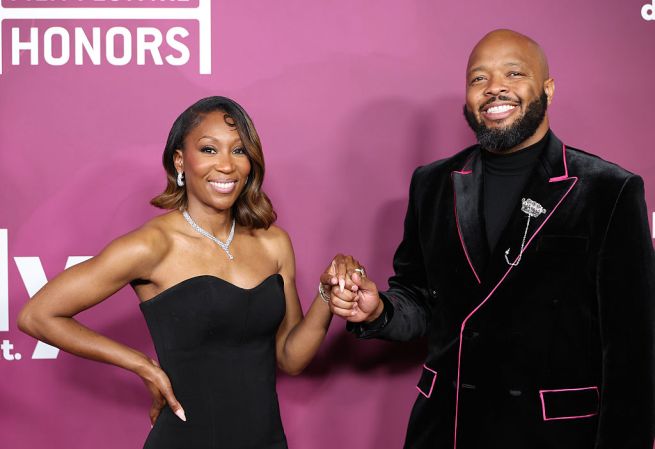
I remember watching Erica Campbell get married like it was yesterday. I was a teenager, sitting in my parents’ sunroom with a bowl of shrimp ramen, watching her wedding to Warryn Campbell on TLC’s A Wedding Story. At the time, she represented what so many of us were taught to aspire to: a beautiful, saved Black woman doing things “the right way.” What’s stayed with me even more than that wedding is who Erica Campbell has chosen to be in the years since.
Over time, she’s been open—never crass, but never coy either—about the fact that she and her husband have an active sex life. She’s affirmed that the marriage bed is, in fact, being used. She’s embraced her curves, her sensuality, her presence as a woman who is both Christian and fully embodied. Recently, in a search for her vow renewal gown designer, she didn’t skip a chance to remind followers that she’d like something sexy. Every time she does, it feels like a disruption. For many of us who grew up in the church, that kind of openness still feels off-limits.
We were given a destination—marriage—but not a real picture of what intimacy looked like once you arrived. For millennials, there weren’t many visible examples of Christian couples who were both deeply rooted in their faith and openly enjoying each other over time. So when couples like Kevin “KevOnStage” Fredericks and Melissa Fredericks, married for more than 20 years, speak candidly about sex, attraction, and the work it takes to stay connected, it feels like a rare window into something we weren’t taught how to imagine. Now, with younger couples like Jayla Henry and Tony Henry or Keith Lee and Ronni Lee showing up online with an easy, playful chemistry, that visibility is expanding.
Growing up, even the closest thing to that kind of acknowledgment felt hidden. If you know, you know: T. D. Jakes had that Sacred Love Songs CD, and somehow we all knew it existed, but also knew better than to touch it, let alone play it out loud. It was one of those reminders that intimacy existed, but only in a way that stayed tucked away. So we learned how to wait, how to avoid, how to suppress—but not how to see desire as something that could live alongside faith, or even as something sacred in its own right. For many of us, sex was never framed as something that could be connected to worship—even though, in its most honest and present form, that’s exactly what it is.
RELATED CONTENT: Dating Without Sex: When to Tell Your Partner You’re Abstaining
The Best Sex of Your Life

In high school, there was a youth week of prayer at my church when a young pastor—married, not even 30, already a father—stood up and preached a sermon titled “The Best Sex of Your Life.” For a room full of teenagers, it was controversial. For me, it was clarifying. He told us that sex within marriage would be the best we’d ever have, not because of technique or experience, but because it would exist without shame or fear. We would thoroughly enjoy our spouses, have no one else to compare them to, and never had to look over our shoulder out of fear of being caught. I remember thinking: If you want us to wait, these are the kinds of things we need to hear. While we were being told to save sex for marriage, there was very little space to talk about what sexuality actually looked like on the other side of that decision.
Growing up, the messaging was clear. Save yourself for marriage. Everything else is a sin. Sometimes it came wrapped in testimony—“I didn’t even kiss my spouse until our wedding day.” Other times it was regret and wishing they would’ve waited.” No matter the tone, the message landed the same. Sex was something to avoid. My body was something to manage.
Even with what I jokingly call a “booty on layaway” build—one that let me move through most days without much attention—I still learned early to dress with the male gaze in mind. Nothing too tight, fitted, or revealing of curves I didn’t even have at the time. Even clothing that simply fit me as intended felt questionable at times. There was always this unspoken expectation that there needed to be…room left for Jesus. It felt like being sexy for your husband, but invisible to everyone else.

What Purity Culture Actually Did to Us
“For a lot of us who grew up in the Christian church, ‘sexy’ was treated as a threat,” says LuzCelenia Arce. “Not just in general, but a threat to the sanctity of the men around us and a threat to our own purity. We were labeled liabilities the moment puberty hit and our bodies began to take shape.”
“I was raised in an extreme version of this,” Arce continues. “I wasn’t allowed to wear dresses above my knees, pants or shorts, sleeveless or v-neck tops, jewelry, or any makeup beyond chapstick. The message was clear. The body God gave me was a problem, and it was my responsibility to manage that problem. Navigating girlhood and womanhood under that kind of indoctrination doesn’t just impact how you dress. It distorts your relationship with yourself.”
“Many of us were set up to struggle with self-esteem and to feel disconnected from our bodies. Not just in terms of pleasure, but in terms of self-knowledge. We weren’t taught to understand our bodies. We were taught to monitor them.” Even the theology we were given didn’t always hold up under scrutiny.
“Verses about modesty were constantly used to police women’s bodies, but when you actually study them in context, they weren’t about hemlines or cleavage. They were addressing displays of wealth, status, and class division…But instead of confronting issues of class and inequality, those teachings were repackaged to control women’s bodies and expression.” Modesty became less about intention and more about control. “It was about covering up, shrinking down, and making sure you weren’t ‘causing’ someone else to sin…Again, the focus wasn’t on self-awareness or mutual responsibility. It was on managing perception and protecting male comfort.”
RELATED CONTENT: Touch, Tease, Transform: How Self-Pleasure Awakens The Confident Goddess Within
The Marriage Reality No One Prepared Us For

In many Christian spaces, sex is framed as the reward for waiting. However, very few people talk about what happens when you get there.
“Whenever sex was talked about it was in the context of marriage and the marriage bed being undefiled, but even then the man’s pleasure was centered,” Arce says. “There was an unspoken assumption that a woman would automatically be satisfied simply by giving her body to her husband.”
I’ve seen how that plays out in real life. Women trying to figure out what they like. Women unsure how to communicate their needs. Women who have never experienced an orgasm and don’t feel confident enough to say that out loud. Women who think sex ends when their husband does, because no one ever taught them otherwise.
“At the same time, boys in these same environments are being shaped by this doctrine too,” Arce adds. “Instead of being taught responsibility for their own gaze and urges, they often receive the message that those urges are inevitable and that women’s bodies are the trigger,” which creates a dynamic where no one is actually equipped.
“So they grow up learning two conflicting things. That sexual women are ‘too much’ or immoral, and that the ‘good’ Christian woman they marry shouldn’t be sexual at all…And now you have two people entering marriage, both deeply disconnected from their own sexuality, trying to build a healthy sex life on top of shame, misinformation, and silence,” says Arce.
“And I would be remiss not to name this,” she adds. “Many of us were taught, intellectually and spiritually, that sex before marriage was inherently sinful. But many Bible scholars have since challenged that framing, pointing out that there was no singular, unified sexual ethic in the text…”
This framing was also most recently challenged by Dr. Delman Coates, pastor of Mt. Ennon Baptist Church in Clinton, Maryland. During his “Let’s Talk About Sex” sermon series, he noted that the word often translated as “fornication” is more likely to refer to prostitution and exploitation–not premarital sex.
For many, that realization alone is enough to begin questioning everything. It took me time—and a divorce—to fully step outside of that framework. That was the moment I began to deprogram, decenter the male gaze, and decolonize my thinking around what it meant to be a woman in my body. Surprisingly, the shift felt natural. It was a return to what felt innate.
One of the first ways I reclaimed that space was through something simple: learning how to take boudoir photos. Not for anyone else to see. As I was scrolling social media during the
It was a quiet but powerful realization: I can be sexy without an audience.
Redefining “Sexy” on My Terms
Sexy, for me, is knowing that this body of mine carries the legacy of the women who came before me—women who switched when they walked, batted their lashes, painted their lips, and leaned into their sensuality enough for me to be here. It doesn’t always look like what people assume. Some days, it’s a Black pop culture tee, jeans, and a pair of worn-in Air Forces. Other days, it’s the way my body responds around my partner. The way my heart picks up pace. The way I receive a compliment—whether it’s from a partner or a homegirl—with ease instead of deflection.
“Finding your ‘sexy’ isn’t about performance or approval,” Arce adds. “It’s about reclaiming agency over your body, being honest about your desires, and allowing yourself to experience pleasure without shame. It’s about coming back into your body. For many of us, that’s where the real healing begins.”
If the church is going to continue encouraging people to wait for marriage, then it also has a responsibility to prepare them for what comes after. That means teaching self-awareness, letting people embrace the sexual beings we were designed to be, and not just enforcing restraint.
RELATED CONTENT: ‘If He Whips Out That Massage Oil, It’s Going Down’ — Naturi Naughton’s Tips For Keeping Marriage Hot [Exclusive]