I Hit My Sexual Peak—And My Partner’s Can’t Get It Up
Her Desire Is Peaking, But His Erections Aren’t—The Bedroom Truth No One Warned Black Women About

There is a moment that comes up again and again in conversations Black women have behind closed doors—not as gossip, not as complaint, but as quiet confusion. It usually starts the same way: nothing has changed emotionally. The affection is still there. The care is still there. The attraction, as far as anyone can tell, remains intact. Physically, something has shifted.
When a partner who once seemed effortlessly present sexually can no longer show up in the same way, the mind does what it always does in the absence of information: it starts filling in the blanks. Is it stress? Is it a distraction? Is it a loss of attraction? Is there someone else? These questions don’t come from insecurity alone. They surface when behavior changes without explanation, and silence is left to do the explaining.
Across conversations I’ve had with my homegirls—women in my age bracket swapping voice notes and late-night texts—a pattern keeps surfacing. Black women in our late 30s and early 40s are often entering a period of heightened sexual desire at the exact same time the men we’re dating, partnered with, or building families alongside are confronting erectile dysfunction (ED). No one prepared us for what happens when those timelines overlap.
RELATED CONTENT: ‘Grey’s Anatomy’ & ‘Queen Sugar’ Writer & Director Felicia Pride On Love After 40: ‘Aging Is A Luxury, Not A Liability’ [Exclusive]
The Desire Myth We Were Handed
For decades, heterosexual relationship narratives have relied on a familiar script: men want sex endlessly, and women eventually cool off. When intimacy declines in long-term relationships, the responsibility is often placed squarely on women—we’re the ones who let ourselves go, we’ve stopped initiating, we’ve failed to keep things exciting. Entire industries exist to coach women on how to reignite desire through date nights, lingerie, libido supplements, and endless advice about being more appealing partners.

Even when erectile dysfunction enters these conversations, it’s often framed as a temporary setback with a simple solution. Take a tiny blue pill to restore function and move on. That framing flattens a much more complicated reality—especially for Black couples navigating the intersection of health disparities, aging, and intimacy.
What the data actually shows is not a failure of attraction or effort, but a convergence of biological timelines that are rarely discussed together.
Research published in Archives of Sexual Behavior found that women between the ages of 27 and 45 reported higher levels of sexual desire than both younger and older age groups, suggesting that desire often peaks in the 30s and early 40s. Reviews of female sexual response further indicate that women frequently reach peak orgasmic frequency in their 30s, with sexual capacity remaining relatively stable through the 40s and into the early 50s in the absence of major health or relational disruptions. Rather than “cooling off,” women at this stage of life often report feeling more confident in their bodies, clearer about their needs, and more interested in sex.

At the same time, erectile dysfunction is closely tied to chronic health conditions that disproportionately affect Black men and tend to be diagnosed earlier than many people realize. Type 2 diabetes, cardiovascular disease, and high blood pressure all impair blood flow, nerve function, and hormonal balance—the very systems required for erectile function. Because Black men are more likely to experience earlier onset of these conditions, ED can appear earlier as well.
Taken together, these overlapping timelines help explain why this mismatch keeps surfacing in conversations among Black women whose partners are otherwise emotionally present and invested. It is not that women want less. It is that we want more at the exact moment our partners’ bodies may be struggling physically.
When Desire And Function Fall Out Of Sync
What often goes unsaid in these conversations is how disorienting this moment can be for women who have worked hard to arrive at a place of body confidence and sexual self-trust. Reaching a stage of life where desire feels expansive, grounded, and unapologetic is supposed to feel affirming. Instead, this mismatch can actively work against the very libido and ease women have spent years cultivating, forcing desire to become something negotiated rather than enjoyed.
Inside committed relationships, this mismatch rarely stays confined to the bedroom. In these conversations, women describe feeling suspended between compassion and frustration. There is care for a partner whose body is not cooperating—whose confidence may already feel fragile—alongside the very real experience of unmet desire.

Across these conversations, adaptation comes up again and again. Toys enter the conversation. Definitions of intimacy expand. Expectations are adjusted in an effort to stay connected, but adaptation does not automatically resolve longing. Wanting closeness does not eliminate the body’s appetite for penetration. And oral sex—while intimate and meaningful—does not always quiet a body that is craving something else. Acknowledging that distinction can feel uncomfortable, but pretending all forms of intimacy are interchangeable often leads to resentment rather than relief.
Emotionally, distance can begin to form. Physical intimacy is one of the primary ways couples reinforce closeness, reassurance, and safety. When that channel becomes inconsistent, partners may start tiptoeing around the issue, afraid that naming it will deepen shame or trigger defensiveness. In these conversations, reassurance becomes reflexive—”It’s okay”—even when it isn’t. Not because needs are unclear, but because protecting a partner’s feelings can feel safer than risking emotional harm.
The Silence Black Women Carry
What stands out across these conversations is how rarely this experience is spoken about openly, even among close friends. Naming sexual dissatisfaction can be interpreted as ingratitude, selfishness, or a lack of commitment to “fighting” for the relationship. For Black women in particular, there is often an expectation of resilience—that we will be understanding, accommodating, and willing to sacrifice, especially when a partner is dealing with health challenges.
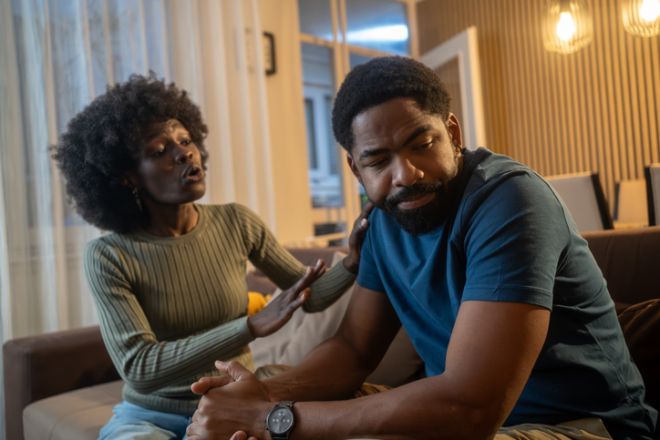
Layered beneath that silence is another fear: scarcity. Across these conversations, a familiar internalization surfaces: that age, motherhood, divorce history, debt, or changes in the body mean asking for more—emotionally or sexually —feels risky. The unspoken message is that wanting fulfillment is a risk when stability itself can feel fragile. However, avoiding the conversation does not protect the relationship. It isolates both partners within it.
RELATED CONTENT: Tabitha Brown Talks Removing The Stigma Of Bladder Leaks: ‘Your Body Is Like, You On Your Own Girl’
What Happens Beyond The Bedroom
“When desire and sexual function are out of sync, people can start to feel disconnected, misunderstood, or even rejected, which can impact self-esteem and emotional safety in the relationship,” says Ashley “Ìyá Ashley” Edwards, Founder and CEO of MindRight Health, a mental health platform designed to make culturally responsive emotional support more accessible, particularly for Black communities. Through MindRight, Edwards pairs users with trained emotional support partners, offering consistent, judgment-free support outside of traditional therapy models.
“More broadly, when any part of a relationship feels out of sync, open and healthy communication becomes essential. Regular check-ins help ensure both partners still feel seen, valued, and emotionally supported as things change over time,” she added.
That misalignment can show up as emotional withdrawal, overthinking, or quiet resentment. It can also place an unspoken burden on women to manage not only their own unmet needs, but their partner’s emotional response to not being able to meet them. While erectile dysfunction is often discussed as a medical condition—which it is—it is also deeply psychological. Shame, anxiety, and avoidance can compound physical symptoms, making intimacy feel tense rather than connective.
How Couples Try To Navigate It
In practice, couples respond to this tension in different ways. Some pursue medical treatment. Others turn to therapy, individually or together. Some redefine intimacy. Others decide the mismatch is something they cannot work through. In some cases, partners explore non-monogamy. In others, the relationship ends.
What tends to be least sustainable is pretending the issue does not exist.
“Whether you’re working through a relationship challenge or a personal health challenge, it’s important to make sure mental health is considered and prioritized,” Edwards says. “This can look like incorporating a mental health routine that includes clinical options like therapy, as well as everyday nonclinical options like MindRight, which pairs you with an emotional support partner through the ups and downs of life.”
The goal is not perfection or performance. It is honesty—about bodies, about desire, and about what both partners need in order to feel connected.
Staying, Leaving, Or Rewriting The Rules
At some point in these conversations, the question shifts. It stops being about how to adapt and starts being about whether adaptation is enough. For some women, that moment introduces choices they never expected to seriously consider—out of honesty about what they can and cannot live with long-term.
For couples who choose to stay together, some begin exploring alternatives to traditional monogamy. Ethical non-monogamy is an umbrella term used to describe consensual arrangements in which partners agree that intimacy— emotional, sexual, or both—may extend beyond the relationship, with transparency and clearly defined boundaries. For women unfamiliar with the concept, the defining feature is not secrecy or betrayal, but consent.
Within that broader category of non-monogamy, some couples discuss swinging, which typically involves partnered couples consensually engaging in sexual activity with other couples or individuals, often together and in shared or social settings. Others encounter conversations about cuckolding, a more specific dynamic in which one partner derives psychological or sexual satisfaction from seeing their partner having sex with someone else.
For other women, the conclusion is more straightforward, if no less complicated: they leave. In some conversations, that decision comes with a reframing of identity—reclaiming sexual agency, or jokingly embracing the label of “cougar” as they venture out with younger partners. While often treated as a punchline, this choice is frequently less about age and more about timing, compatibility, and the refusal to negotiate away sexual fulfillment.
None of these paths are inherently more enlightened, liberated, or selfish than the others. They are responses to a reality women did not create but are often expected to quietly manage. What matters most is not which option someone chooses, but whether that choice is made without shame, secrecy, or self-betrayal.
The Conversation We’re Late To
What makes this conversation overdue is the way responsibility for sustaining intimacy continues to fall disproportionately on women. We are told that long-term relationships lose sexual energy because women stop trying, stop caring, or stop being desirable. Far less attention is given to how often women remain fully interested, fully engaged, and fully desiring—while navigating partners whose bodies are no longer responding as they once did.
Erectile dysfunction does not make someone a bad partner. Wanting a fulfilling sex life does not make someone selfish. Both truths can exist at the same time. The real failure is treating this mismatch as rare, taboo, or unspeakable instead of recognizing it as a common crossroads that many Black couples encounter earlier than expected.
If these conversations happened sooner—without shame, without cruelty, and without secrecy—fewer women would feel alone when their bodies wake up and realize the story they were told about desire no longer matches their lived reality.
RELATED CONTENT: Touch, Tease, Transform: How Self-Pleasure Awakens The Confident Goddess Within