Appreciation Letter To Toni Morrison
Thank You So Much Toni Morrison
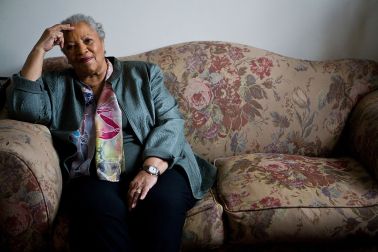
Source: Timothy Fadek / Getty
There are mothers whom when they join the ancestral realm we feel the gap.
Their arms hold us and bear the weight of a repeated burning that we feel as Black women. Too Black, not Black enough, too nappy, too fat, too skinny, too sexual, not sexual enough, too loud, not boisterous enough. Always wrangling with what is perceived and what is believed. Knowing that at the essence we are the root, but always fighting, fighting, to keep the root from being plucked out.
Toni Morrison entered my world as a literary mother. That notion of daughterhood is taken as a silent vow by any Black woman/Black femme writer who wanted to do the hard, painful work of skinning themselves to pour heart and truth onto the page. Writing is that way. It is surgery and Toni was a master surgeon as a wordsmith. She did not cower at her position as a writer, nor did she doubt her exceptional abilities.
I gained knowledge of self through her soaring novels, The Bluest Eye and Song of Solomon. The former, whose protagonist was anchored down with the weight of life as a dark-skinned Black girl, and the latter, which profiled a Black family’s legacy and the symbolism of flight. I never thought about the juxtaposition of those stories until now. I became enthralled with her narrative on generational curses, loving widely, clumsily, and purposefully.
And that was the thread that bound her to many of us. A profound, mysterious, yet observant woman who showed us ourselves on the page. In her documentary, Toni Morrison: The Pieces I Am, she described her influence as a hand reaching out to meet another hand silently in the dark.
Until Tuesday, I had not known a world without Toni Morrison. And though death is imminent for every idol that we’ve ever held up, I never tried to imagine a world without her. I weep for all the unborn Black girls who will come to know her in past tense. But I rejoice at the idea that hopefully, one by one, through her self-proclaimed literary daughters, they will discover her brilliance and her unabashed placement of Black womanhood at the core of her work.
It didn’t feel right writing anything down about her until at least 12 hours had passed. I cried a lot. I thought about how she found the time to write in between caring for her two sons and holding a full-time job as an editor. Friends spoke of how she would rise with the sun to scribble down thoughts, how she would take notes while driving, during stolen moments of time. I think about her advice for young aspiring writer’s often, who she warned to not begin writing professionally until you reach 40, based on the notion that her first book, The Bluest Eye, was not published until she was 39-years-old.
But once I rose up out of the idea that she was mine alone, I realized all around me, so many of us were heartbroken. And I needed more than anything to be in community where what’s understood didn’t need to be said.
I gathered with her tribe at Ode to Babel, a bar owned by two Black sisters in Brooklyn on Tuesday and we read her passages and laughed and cried and stood in awe of this literary titan to which we can be assured we will never know the likes of again. And maybe that is part of the depth of pain—the understanding that genius is not flippant. Genius is deliberate and tedious.
I feel the hand urgently pushing me to continue the work of writing. To not give up at every happenstance that life throws the way of a Black woman. To continue pounding at the pen and the keyboard until it hurts, so that my labor lessens the burdens for someone else. To feel free enough to write about who I am and what we’ve overcome, or have yet to traverse. And if we feel lost, we can always find her right there on the page.
That is what she did for me and a multitude of others. An unpaid debt we owe her into perpetuity.
“And she was loved!”
And she was loved!
And she was loved.