
All Articles Tagged "emergency contraception"
Really, a ‘Morning After Pill’ Vending Machine?
There’s pretty much no reason for anyone to accidentally get pregnant these days, particularly on Pennsylvania University’s campus, unless students are just being totally reckless.
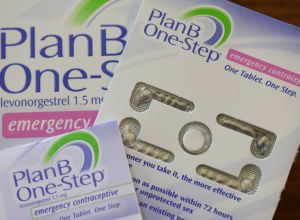
In case anyone on the campus passed up the condom aisle at Walgreens or decided to take a risk and go raw one night, they can now obtain Plan B, also known as the morning after pill, from a vending machine located in the campus health center.
According to NewsOne, Roger Serr, Vice President for Student Affairs, says the machine was installed after a request from the student association and a follow-up survey found that 85 percent of students supported it.
Plan B, which is already available without a prescription to girls 17 and older, isn’t covered or subsidized by the school. Students are charged $25 for the pill, which is the school’s cost to the pharmaceutical company, and less than what pharmacies off-campus charge. In addition to the emergency contraceptive, students can also purchase condoms, decongestant, and pregnancy tests from the machine.
I guess if access to preventive methods is a big issue in the Shippensburg, PA, area then the campus has that covered.
What do you think about this method? Is it progressive or too casual of a way to deal with something so serious?
Brande Victorian is a blogger and culture writer in New York City. Follower her on Twitter at @be_vic.
More on Madame Noire!
- You Mad? 7 Signs That Your Attitude Is Hurting You More Than Others
- Does Dating White Trump Your Black Card?
- Swapping Spit: 7 Gag-Worthy Celebrity Kisses
- Dangerously In Love: Warning Signs To Protect Your Heart From Harming You
- My Name is My Name: Why We Need to Do Better in Naming Our Children
- LORD, Take Me Now! Signs You Hate Your Job
- Can You Marry Someone You Don’t Love?
- Hair Q&A: Work-Out Styles and Heat Damage
Pharmacies Inaccurately Denying Plan B to Teens
The U.S. Department of Health and Human Services’ recent decision to deny Plan B from being made available over the counter without age restrictions kept current regulations in place that allow 17-year-olds to readily pick up the morning after pill, while those 16 and under require a prescription. Some pharmacists seem to have missed the memo, though, as a recent study shows a decent number have denied the pill to teens who were of age.
Researchers at Boston Medical Center called 943 commercial pharmacies in five states using a caller who posed as a 17-year-old girl seeking emergency contraception after unprotected sex. Of the pharmacies that said they had emergency contraception available that day, 19 percent said the 17-year-old caller could not buy the emergency contraception under any circumstances; these pharmacists also usually hung up the phone quickly.
Misinformation was more common in poor neighborhoods with 23.7 percent of pharmacies in low-income neighborhoods telling the teenage caller she could not obtain emergency contraception at all, compared with 14.6 percent in other neighborhoods. While telling the teen that she needed a prescription would have still been inaccurate, it would have at least given her an opportunity to try to access the pill.
A little less than half of the pharmacies (44 percent) also gave the incorrect age at which a teenager can obtain emergency contraception without a prescription. Most of those who got it wrong said a person had to be older than 17 to obtain Plan B. In low-income neighborhoods, about 50 percent of pharmacies gave the incorrect age, compared to about 37 percent in other neighborhoods.
The researchers say in-person visits may have yielded different responses but that shouldn’t be the case. It’s no wonder teens are unclear about how to get pregnant, or not get pregnant, and prevent STDs—the medical professionals who are supposed to offer guidance don’t even know the answers. Next time a study questions why there are higher rates of these issues in low-income neighborhoods, they should delve deep into the lack of proper education not just for teens but for the professionals around them.
Are you surprised by this finding?
Brande Victorian is a blogger and culture writer in New York City. Follower her on Twitter at @be_vic.
More on Madame Noire!
- Evening Eye Candies: 6 HOT Reasons to See “Red Tails” NOW…The Delicious Cast
- Sisters In Hiding: Not So Famous Sisters of Famous Celebs
- Delusions Of A Thirsty Chick
- Racism? Why I’m Not Surprised By The Help’s Nomination For Best Picture
- 7 Curl Defining Products to Get Your Curls and Coils Poppin’
- Traits of Trifling Parents
- He Loves Me: Men Who Just Adore Their Wives
- New Documentary Gets ‘In Our Heads About Our Hair’
No Plan C for Morning After Pill
U.S. Department of Health and Human Services Secretary Kathy Sebelius shut down the FDA’s recommendation that Plan B One-Step emergency contraception, also known as the “morning-after pill,” be made available over the counter without age restrictions yesterday.
While FDA Commissioner Margaret Hamburg said the science proves that the pill is safe and effective for all women of child-bearing age, Sebelius said that doesn’t necessarily mean girls are mentally and emotionally responsible to handle the freedom that goes along with making the pill available without a prescription. Therefore, women ages 16 and younger must continue to obtain a prescription to access Plan B, while women 17 and up can simply ask for it at the pharmacy. She said in a statement:
“The switch from prescription to over the counter for this product requires that we have enough evidence to show that those who use this medicine can understand the label and use the product appropriately. I do not believe that Teva’s [the manufacturer of the drug] application met that standard.”
I agree with Sebelius’ point of responsibility, but I think it’s also important to look at the potential for greater good. If young women can’t access Plan B within 72 hours of having unprotected sex, will they continue to resort to more extreme measures or have to deal with unwanted pregnancies? If there’s concern about young girls understanding product labels, why not simplify the language and enforce a policy that would require pharmacists to more thoroughly explain the pill and its side effects?
The goal of Plan B is certainly not to have young girls popping pills as a first line of defense against pregnancy—or to mistake it as a barrier to disease—but with girls engaging in sexual activity at increasingly younger ages, it seems only a matter of time before age restrictions have to be lifted.
Do you agree with Sebelius’s ruling or do you think the pill should be available over the counter to all women, regardless of age?
Brande Victorian is a blogger and culture writer in New York City. Follower her on Twitter at @be_vic.
More on Madame Noire!
Somebody Lied To You: People Who Swear They Can Sing But Really Can’tKelly
Rowland’s Hair Masterpieces and Messes Over the Years Risky
Behavior: 6/10 Americans Didn’t Use Protection First Time They Had Sex
Ask a Very Smart Brotha: Short Dudes & Caribbean Cuties


