
All Articles Tagged "harriet tubman"
What Rosa Parks Can Teach Us About Standing For Something And The Benefits Of Being The “Angry” Black Woman

AP Photo/Paul Sancya
It’s Black History Month, so let’s talk about Rosa Parks.
For the 100th birthday of the great civil rights icon, Charles Blow, columnist at the New York Times, gives another side to Parks, challenging the commonly told narrative that Parks refused to give up her seat because of her tired feet:
“I didn’t tell anyone my feet were hurting,” the book quotes her as saying. “It was just popular, I suppose because they wanted to give some excuse other than the fact that I didn’t want to be pushed around.”
The book in which Blow writes about is The Rebellious Life of Mrs. Rosa Parks, by Jeanne Theoharis. According to Blow, the book asserts that Parks’ image had been “sanitized and sugarcoated” in order to easily feed the masses. Despite always being portrayed as “humble” and “soft-spoken,” the book argues that in fact, Parks was a high-strung and proud woman, who used to sit vigil with her grandfather (a follower of Marcus Garvey) and his shotgun, hoping to one day see him take out a K K K member. Writes Blow, “That day came on Dec. 1, 1955, when a bus driver asked her to get up so that a white man could sit. She refused. This was not a spur-of-the-moment decision. It was a political calculation informed by a life of activism. As Parks put it, “an opportunity was being given to me to do what I had asked of others.” Blow then goes on to say the Rosa Parks in this book is as much like Malcolm X as she is Martin Luther King Jr.
I haven’t read the book, but I’m adding it to my Kindle queue because it sounds like a great alternative to the insipid history lessons we always get around civil right icons like Parks. Although, Parks history of radicalism has been documented in before, particularly in the book, At the Dark End of the Street: Black Women, Rape, and Resistance–A New History of the Civil Rights Movement from Rosa Parks to the Rise of Black. Power, which highlights Parks’ pre-bus sitting radical work as an investigator for the NAACP, who specialized in investigating sexual assaults against black women in Jim Crow Alabama. One particular case involved the sexual assault of a 24-year old mother named Recy Taylor, who was brutally and repeatedly sexually assaulted by six white men in Henry County, Alabama. According to the book, it was this case, in addition to others, which served as the spark to the Civil Rights Movement and the Montgomery Bus Boycott.
The old saying is that well-behaved women rarely make history. This is true, but there is also a desire to sanitize them; to make them into a shell, although beautifully painted, than what they were. Parks might have been a quiet, patient and an unimposing woman, but she was also bold and assertive too. And it is important that we get to see Parks in the later context as much as we see her portrayed in the former. Bold and assertive are among the traits that women, particularly black women, are the most picked apart about. People wonder what would have happened to the movement if Parks would not have boarded that bus that day. I think about what if she had boarded that bus and had the whole thing recorded and uploaded to the Internet? Would she have still garnered the same sort of empathy and admiration from the public if we saw a Parks in contrast to the tired seamstress on her way home from a long day at work, but rather a firecracker, who refused to give up her seat based on the sheer principle of it? I imagine that it would be even hard for some folks, including some black folks, to sympathize if they viewed just how vibrant and not helpless she really was that faithful day.
And that’s not to compare Parks to the hyper-aggressive street violence we see in videos on sites like WorldStarHipHop, it’s however, to point to how often we misunderstand or are dismissive of black women who dare to be outside of the framework of “proper” womanhood. In one sense, we can understand the anger of a black man, who had been victimized and continually denigrated by systematic oppression, yet through that same lense, treat black women, who might act out in the same sort of systematic anger, as the perpetrator of her own victimization. We mock her, call her crazy and in some instances applaud when she finally writes a check that her mouth can’t cash. And yes, nine times out of ten that offense has to do with her mouth. She is too loud, too opinionated; too brass. If only she would learn to be quiet, learn to smile more and understand her virtue of submission, all the problems we have in the community would just melt away.
Ironically, it is the “disobedient” black women, with their non-yielding attitudes, which more often than not helped to progress the community in some way, shape, form or fashion. Women like Ida B. Wells and Mary Church Terrell, who used their mouths to spread the urgency of the lynchings in the South. And it was the plain-spokenness of black women like Fannie Lou Hamer, who galvanized the Mississippi communities through Freedom Summers to organize against the Jim Crow South. Harriet Tubman and Sojourner Truth engaged in acts of rebellion by not only escaping slavery, but leading others, who fled North and West. In fact, being soft-spoken and delicate is a privilege, which has never been afforded to black women, as told by Truth at the Women’s Conference, delivered in 1851.
“That man over there says that women need to be helped into carriages, and lifted over ditches, and to have the best place everywhere. Nobody ever helps me into carriages, or over mud-puddles, or gives me any best place! And ain’t I a woman? Look at me! Look at my arm! I have ploughed and planted, and gathered into barns, and no man could head me! And ain’t I a woman? I could work as much and eat as much as a man – when I could get it – and bear the lash as well! And ain’t I a woman? I have borne thirteen children, and seen most all sold off to slavery, and when I cried out with my mother’s grief, none but Jesus heard me! And ain’t I a woman?”
You can’t be a docile woman, overly concerned about manners and proper womanhood if you want to lead a group of people from slavery – particularly black folks. Anyone who has ever tried to engage black folks in any form of cooperative building knows how damn difficult it is to even get us united for something as simple as a meeting – let alone an escape from slavery. And by virtue of either biology, environment, or the subjugation experienced through slavery and hundreds of years of oppression, not every woman is going to be soft and meek. And quite frankly, that’s a good thing. We need our angry black women with their big mouths to be that burst of fire, which ignites us into actions and new ways of thinking (but clearly not angry and loud just to be angry and loud). That’s why today I feel a special need to acknowledge the real Rosa Parks, not just for historical accuracy, but for all the young, black and loud mouth jump starters out there, trying to make sense of why they can’t fit in nicely to this narrow definition of womanhood. Truth is, like the ancestors before you, you weren’t meant to be proper; you were meant to speak out.
Colorism in the Abe Lincoln Vampire Hunter Film and Why It Does Matter

Kola Boof, Egyptian-Sudanese author and professional jump starter, has started a campaign against Timur Bekmambetov and Tim Burton, the production team behind Abraham Lincoln: Vampire Hunter, for their inaccurate portrayal of historical figure Harriet Tubman.
Releasing a statement through her Facebook page, Boof writes, “HARRIET TUBMAN…. is portrayed as “BIRACIAL” in the new “Abe Lincoln Vampire” movie…. TO ME….you have to really *HATE* Black people to portray Harriet Tubman as a Biracial woman. It reveals everything about White Supremacy and the “erasure” of Black People. Harriet was NOT Dutch speaking or Biracial. And this portrayal is really a “Betrayal”…. it does not honor her image. It OBLITERATES not only Harriet, but all Authentic Black Women.”
She also advised folks to call and write the studio and various production companies to express our displeasure about this misrepresentation. Said Boof, “We can’t change this particular movie….but we can let Hollywood know that we don’t like seeing the constant *Whitening* of Black images in films…that we DO want to see Black people in movies and not be disrespected like this. If we don’t speak up BLACK WOMEN, then nothing will change…”
Listen I know when folks hear Kola Boof’s name they instantly tune out. But while Boof may be many things to people – most of them not so nice – one thing she is, is honest as well as fierce protector of all things related to darker skinned women. And while this might be a hard pill to swallow for some, she has great reason to be.
Jacqueline Fleming, a Copenhagen Denmark born actress of African American (father) and Danish-German (mother) descent. You might have seen her on television in shows like “CSI: Miami” and “Treme” or on the big screen in movies Last Holiday and the sequel to Woman Thou Art Loose. She has also been casted as Harriet Tubman in Abraham Lincoln Vampire Hunter.
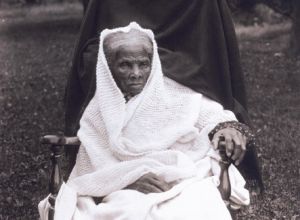
For those of you who have no idea who Tubman is, shame on you and the wack educational system you derived from. Tubman was born somewhere around 1803 to Ashanti enslaved parents and was bestowed the title as Moses for braving 19 trips into slave holding states and leading some 300 individuals to a new life in slavery-free territories – not an easy feat for a runaway slave, who had over $40,000 reward posted all over the South for her capture or death. Oh another thing about Tubman; she was dark-skinned. Dark enough not to pass for a light skinned woman of mixed ancestry. Which is why on one of her trips, she had to convince a light-skinned fugitive slave to pose as a white master transporting a group of slaves to a town further up the road.
Not too many people want to discuss this issue, which was evident by a column from my good friend Yvette Carnell, who recently penned a piece about this misrepresentation of Tubman in the film. For Carnell and I, who discussed this briefly on Facebook, Hollywood’s attempt to use Fleming’s image to whitewash Tubman was a no-brainer. And in a time when black folks are bombarded with distorted images of ourselves, we felt it our duty to call it out. However, not that many other folks didn’t see it that way and proceeded to blast her piece as trivial. They accused Carnell of being bitter, divisive and color-conscious. After all, it’s a stupid movie about Abe Lincoln being a vampire hunter and we all know that he wasn’t in real life. Likewise, we’re all black so it shouldn’t matter, which color of blackness she exhibits.
Well I’m here to tell you it does matter.
Harriet Tubman Arrives at DC Wax Museum
![]()
A wax sculpture built in Harriet Tubman’s likeness was unveiled in the President’s Gallery at the Madame Tussauds D.C. branch earlier this week.
Tubman, who led hundreds of slaves to freedom via the Underground Railroad, is one of many African American historical figures to join the Tussaud collection.
Her oldest living relatives, great-great-great-grand-nephew, Charles E.T. Ross, and Tubman’s great-great-grand-niece, Valery Ross Manokey, pictured above, were present at the unveiling.
Get the rest of the story at theGrio.com.
More on Madame Noire!
- Boy, Bye!: 6 Stupid Reasons to Turn a Man Down
- Hair Raising: Iconic Women Who Changed the Standard for Black Hair
- Does Dating White Trump Your Black Card?
- 7 Things That Should Never Happen In The Bedroom
- Dangerously In Love: Warning Signs To Protect Your Heart From Harming You
- Are You A Coward When It Comes To Breaking Up?
- Can You Marry Someone You Don’t Love?
- So, What Do Their Moms Look Like
Link Love: Va-Jay-Jay Grooming, Men Who Live at Home & John Singleton
Is waxing your lady parts part of your beauty regimen? Maybe you should think about putting it on the list. Check out these tips over at our sister site
Styleblazer
Now that Martin Luther King has his own memorial, a great niece of Harriet Tubman is attempting to create national parks that would honor the Underground Railroad conductor.
theGrio
Brilliant director John Singleton shares his road to success, including the trials and triumphs in his interview with
Uptown Magazine
Is a man automatically out of the question if he still lives at home with his parents? Maybe it’s time for you to reevaluate. Check out this piece at Hello Beautiful and see if you change your mind.
TMZ obtained legal documents that prove soul singer, Chaka Khan, was awarded custody of her 10 year old granddaughter because both of the girl’s parents abuse drugs. Get the rest of this bittersweet story at
TMZ
Just yesterday we were talking about the plea to halt the execution of Texas inmate Duane Buck? Well the Supreme Court granted the request. Read the full story over at
Black Voices


