

All Articles Tagged "safe sex"

We’ve Got To Be More Careful: The Double Standards of Safe Sex

May 22nd, 2012 - By Toya Sharee
Share to Twitter Email This

When it comes to maintaining our sexual health, the odds are already stacked against us just for being female.  STIs can cause a lot of complication in anyone’s life, but for women especially, STIs can cause complications and irreversible damage that simply just won’t occur in the lives of our male counterparts.  Take a look at the list below for several facts that give women a disadvantage when it comes to practicing safe sex:

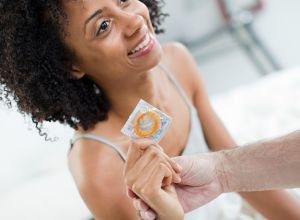
5 Ways He’ll Try to Get Out of Wearing a Condom

May 11th, 2012 - By madamenoire
Share to Twitter Email This

From YourTango.com

It doesn’t matter how charming he is. It doesn’t matter how Hot he is. Your health is still the number one priority.  If you are prepared when he bats his eyelashes and runs his very Hot hand up your thigh, you will stay in control of both your safety and your pleasure. Here are the top five excuses men use to attempt to wiggle out of wearing a condom and the responses you need to stay safe.

Excuse #1: Birth control is the woman’s responsibility.

Sadly this is not a new argument. Ancient Egyptian, Greek and Roman cultures all thought the same thing, and that is why you won’t see many references to condoms in their ancient literature. In fact, the only references to “male birth control” you may find in their writings refer only to “coitus interruptus”—that’s the “pull-out” method, by the way —and anal sex. Puh-lease!

Find out the other ridiculous reasons why your man may try to get out of wearing a condom at YourTango.com. 

More on Madame Noire!

In Between The Sheets: Things All Women Are Insecure About In Bed

April 14th, 2012 - By Julia Austin
Share to Twitter Email This
"Woman looking at boyfriend in bed"

terrancedean.blogspot.com

Next time you’re watching professional Adult Videos (if that’s something you’re into) just remember the camera person knows just what angles make the female look the hottest.  The female herself isn’t really enjoying herself so she can actually think about every little movement she makes, and some moments of the, um, encounter were left out of the finished production altogether. If only we had such finesse in our own sex lives. Luckily, real couples have a lot more fun, but these uncomfortable dynamics still exist….

Read the rest of this entry »

Teen Pregnancy Rates Drop Nationwide

April 12th, 2012 - By Toya Sharee
Share to Twitter Email This

Source: MomLogic.com

The CDC released a report recently, revealing the U.S. teen birth rate decreased again in 2010. Almost every state saw a decline in teen births from 2007-2010, but Arizona experienced the biggest drop at 29 percent.  In fact, U.S. births by mothers of all ages dropped in 2010, and experts cite the economy as the biggest factor.  Although the highest rates of teen births are still found within the Black and Latino communities, the decline was seen among all races and ethnicities.

Mississippi, New Mexico, Arkansas, Texas, Oklahoma and Louisiana still lead with the nation’s highest teen pregnancy rates.  New England states including New Hampshire, Vermont, Connecticut and New Jersey continue to have the lowest teen birth rates in the country.  The report defeats the stereotype that teen pregnancy is limited to urban areas and sex education and pregnancy prevention efforts may have also significantly influenced the falling rate.

With an unstable economy and employment rates staggering to grow, it may very well be that teens and people in general are seriously considering the costs associated with building a family.  Offered more options when it comes to accessing birth control and relieved from the pressure of affording sexual healthcare, more women are choosing to take advantage of the contraceptive options that are available to them.   What’s important about this study is that somewhere, for some reason, young people are listening and actively choosing not to become teen parents.  It brings to light that traditional, more conservative states may benefit from welcoming alternatives points of view when it comes to sex education.

Why do you think that teen pregnancy rates are decreasing?

More on Madame Noire!

Campaign Wants You to ‘Check-In’ and Share Safe Sex Experience

March 5th, 2012 - By Brande Victorian
Share to Twitter Email This

With Social Media, we virtually tell people what we’re doing and where we’re doing it every minute of the day, why not add sex to the mix—only if it’s safe, of course. That’s the aim of a new web-based campaign from Planned Parenthood called Where Did You Wear It.

Using scannable QR codes on the back of condoms distributed by Planned Parenthood, users can log on to a location-based site and share their protected sexual experience. A sample check-in would look something like this:

An under 20 girl and a guy whose relationship is all about love, and have already talked about safer sex and STDs, used a condom in the bedroom to prevent an unplanned pregnancy. It was ah-maz-ing — rainbows exploded and mountains trembled.

The approach seems to be that nothing’s wrong with safe sex so why not share it, although for some this is a bit TMI. There’s also an element of “see everybody’s doing it” but in a positive way. Maybe if people see how many other people are having positive experiences discussing and having safe sex, they won’t think twice about doing it themselves.

The site isn’t all about poking into stranger’s love lives either—although you can search who’s doing what by age, gender, orientation, and state. There’s also health information on STDs, proper condom usage tutorials, and a search engine to find the nearest Planned Parenthood health center. You can’t deny Planned Parenthood is thinking outside the box.

What do you think about the Where Did You Wear It Campaign? Will it really encourage people to have safe sex?

Brande Victorian is a blogger and culture writer in New York City. Follower her on Twitter at @be_vic.

More on Madame Noire!

Breaking Barriers: When Should You Decide to Have Unprotected Sex?

February 16th, 2012 - By Toya Sharee
Share to Twitter Email This

Whether it’s 6 months into a relationship or 6 years, there comes a time when partners may question if it’s even necessary to use condoms anymore. Unfortunately, this is a decision that is often made casually and unclothed in the heat of the moment, but there are some people who invest the consideration and thought into this major health decision that it deserves.

Whether it’s lack of access, relationship status or the most popular reason, “It just feels better,”  the decision not to use protection opens a sexual relationship to a variety of risks.  Many women feel that as long as they’re on birth control if they’re in a monogamous relationship with a man they trust there’s nothing wrong with losing the latex after some time.  Others simply don’t ever take the thought of using condoms that seriously whether they are having sex with someone they’ve known for a day or a decade.  In fact, in 2010 an article published by Reuters entitled, “Condom Use Routine for U.S. Teens, not Adults”, states that teens are more likely to use condoms than adults over 40.  In a study, public health officials found that one in four acts of vaginal intercourse involves condom use, and among single adults that figure is one in three.  Condom use is higher in African-Americans and Hispanics than whites, and lowest among all races for people over the age of 40.

Many are quick to assume that single people are the only ones who are gambling with their sexual health by choosing to have unprotected sex and for most people it’s almost a given that there’s no point in using condoms when you’re married.  The truth is that exchanged vows and a wedding band can only protect you so much from sexually transmitted infections.  Like any relationship, some partners are asymptomatic and without being tested are unaware that they have anything to infect their partner with, whether that partner is a wife or a girlfriend.  And while we’re being honest, marriage doesn’t guarantee monogamy, which means that even in a marriage the decision to not use protection is something that involves a lot of factors, namely trust.

So how much do you trust that your partner is only sexually active with you?  One of the first steps you can take is any sexual relationship is having open, honest communication about sexual history and values.  While we all know that “men lie, women lie, numbers don’t.” Give your partner an opportunity to tell the truth about the number of partners he/she has had in the past and keep in mind that the more partners someone has had, the more likely it is that he/she has been exposed to an STI.  The next important step is to get tested together.  It’s important to not just take things at face value; all too often, people rely on the fact that someone “looks” healthy and become too complacent to take an active step to get tested.  By getting tested together (and hopefully receiving negative results) you both start off with a clean slate; this way if STI symptoms do appear, you know that somewhere along the line someone was unfaithful.   Before getting tested, talk about how the results (whether negative or positive) will affect the relationship.  The last step that a woman can take is making sure that even if she is protected against unintended pregnancy by choosing a form of birth control that works for her particular lifestyle.

Since marriage itself can’t always guarantee fidelity, is there ever a right time to not use condoms? When it comes to sexual health we are often bombarded with messages of safer sex that place emphasis in using condoms correctly and consistently, but it’s important to remember that it’s not enough just to use condoms, you also have to make a well-informed decision about the person with whom you choose to have sex as well.  Also, don’t fall victim to the belief that once you’ve had sex without a condom there is no turning back.  Relationships and people grow and change, and although you may have initially agreed to not use condoms, this decision should be addressed from time to time to make sure both partners still feel the same way.

Regardless of what type of relationship you’re in and for how long, by choosing not to use condoms you are placing your health at risk.  Essentially, you’re leaving your sexual health in the hands of someone else.  Hopefully that person is someone you trust, and for most people trust is built throughout a long length of time and based on more than the physical pleasure and sexual attraction.

Consider the following before making the decision to break down your barrier method:

  • What kind of relationship am I in?  You may think you’re in an exclusive relationship, but your partner may have other ideas about exactly what qualifies as monogamy and/or cheating.  You may think cheating is doing anything sexual with anyone besides your partner, but he may believe 0-ral sex doesn’t count as cheating, leaving your health at high risk.  Be clear and specific about what’s expected in the relationship.
  • What type of birth control works for me?  Some women may find that after they’ve made a decision to not use condoms, they experience difficulty in finding a method of birth control that works for them.  Some women experience uncomfortable side effects with some hormonal methods.  If pregnancy is an issue for you, make sure to give your body time to adjust to a method that you are sure you can use correctly and consistently BEFORE choosing to not use condoms.
  • Do I trust my partner?  If you’re in a relationship where you feel constantly compelled to check his social networks and cell phones for signs of infidelity, you probably shouldn’t be thinking about losing the latex just yet.
  • How long have I known my partner?  Although time doesn’t necessarily guarantee trust, you definitely increase your chances of making well-informed decisions about sex and contraception when it’s with someone you’ve known for several years as opposed to several days.
  • Am I being pressured to not use condoms?   The decision to not use condoms should be something that both partners agree on.  Partners shouldn’t feel pressured because one partner feels like condoms mean they aren’t “trusted” or because they think condoms are uncomfortable.
  • Can I communicate honestly with my partner?  A conversation about sexual values and history can quickly turn uncomfortable, and you may hear things that you don’t like.  Although your partner may reveal some questionable things about their sexual beliefs or history, try to appreciate their honesty.  A tense and touchy conversation about sex is always better than a non-existent one.

Toya Sharee is a community health educator who has a passion for helping young women build their self-esteem and make well-informed choices about their sexual health. She also advocates for women’s reproductive rights and blogs about everything from beauty to love and relationships. Follow her on Twitter @TheTrueTSharee.

More on Madame Noire!

7 Things That Should Never Happen In The Bedroom

February 7th, 2012 - By Julia Austin
Share to Twitter Email This

"Black couple in a fight in bed"

It’s said that men think with their…well, you know. And that is particularly true in the bedroom when things are getting hot and heavy. But just because a man’s animal instincts may kick in, that is no excuse for manners to go out the window. Don’t ever let a man get away with these things (i.e. if he does them, get dressed and walk out):

Sexual Health Myths Even Adults Believe

January 30th, 2012 - By Julia Austin
Share to Twitter Email This


"Black couple in bed"

You use condoms. You sleep with guys who run in the same social circle as you, so you know who they have slept with. You think you’re being safe. You think you fear what you should fear, and are taking all the right precautions. But, sadly, there are a lot of myths that somehow survived through high school, through college and even into adulthood about sexual health. Like these:

7 Things Grown Women Don’t Fall For

January 17th, 2012 - By Julia Austin
Share to Twitter Email This

"Woman holding sledge hammer"

The less experience you have, the less you have to compare to. But, after you’ve been out there for a while as a single female, there are just some things that you discover are complete BS. Like these:

The Secret Life of the African-American Teenager

December 27th, 2011 - By Toya Sharee
Share to Twitter Email This

When you teach sex-ed in the inner city, you manage to be less and less shocked about the secret sex lives of teenagers.  I’ve heard detailed defenses about how effective the pull-out method is as a birth control method and how ear wax is a reliable tool for STI testing.  But last week I found myself picking my jaw up off of my desk as I read Brande Victorian’s 1 in 13 Girls Has Had Gro*up Sex which highlighted a study researching the growing fad of gro*up sex among Boston-area teenagers.  The study appeared in the Journal of Urban Health: Bulletin of the New York Academy of Medicine and revealed that 1 in 13 girls had engaged in at least one type of multi-person sex (MPS) ranging from gang rape to sex parties.  What’s even more concerning is that more than half of the 328 girls surveyed in a Boston-area community or school-based clinic revealed that they felt pressure to engage in gro*up sex that was more often than not non-consensual.

Researchers from the Boston University School of Public Health identified certain common factors that teens engaging in MPS had “a strong association between exposure to pornography.”  If you look hard enough you can find a variety of culprits to take the blame for what seems to be an increasing pattern of teens challenging the sexual norms of society.  With a simple mouse-click and a quick yes to a pop-up that questions, “Are you over 18?  Please enter your birth date,” any adolescent who passed basic math can access free Adult Videos with insulting ease.  You can also turn on the radio and hear artists like pop favorite Rihanna chanting about S&M and Usher beckon a sexually liberated Nicki Minaj to proposition girls in a club and bring them to him so they can play in each other’s pants.  Give your teen a little credit; they could probably teach you a thing or two about taboo sexual behavior, although when experimenting with sex I’m willing to bet Usher is the last thing on their minds.

It’s not so much the case of teens being overtly sexual and pushing the boundaries of what’s socially acceptable, but more their willingness to express these sexual values.  As our society grows more and more sexualized, young people feel more comfortable expressing their sexual attitudes and are willing to accept behaviors that traditionally may have been viewed as abnormal.  On a positive note, alternative lifestyles can be viewed regularly on TV and teens are becoming more informed that all types of sex (even the ”freaky” stuff) can put them at risk for STI’s.  On a positive note, I feel like our society is moving in the right direction when teens feel they can be open and honest about sexuality.  A teen that feels free to talk about masturbation, pornography or gro*up sex may also feel just as comfortable asking about condom use and birth control.  It’s almost as if America is slowly awakening and thinking, “OK, teens have sex, what can we do so that they can make good decisions regarding their sexual conduct?”  As frequent as sexuality appears in our media, it makes sense that sexual education appear just as much if not more.

If I’m completely honest with myself, I’ve been hearing rumors about “trains” being pulled on girls and “Rainbow Parties” (that have nothing to do with gay pride) since I was in high school.  But I always felt that I had a choice as to whether or not I engaged in those types of activities.  One-third of the teens who participated in the study used drugs or alcohol prior to their most recent experience and even felt pressure to be “liquored-up” by their sexual partners.  This makes me question why such a large number of our teens are lacking the confidence to stand up for their sexual values.  I’m not the biggest fan of teens engaging in risky sexual behaviors or having multiple partners, but the truth is these teens will grow into adults who are free to engage in whatever taboo practices they wish as long as they aren’t hurting themselves or one another.  The important thing is that they have the confidence to give or deny consent which it seems our teens are obviously lacking.

As parents and other caregivers, we only have so much say in the sexual interests of our teens, but the best we can do is make sure they are making well-informed decisions whether they’re diving into the waters of sexual deviance or simply dipping their toes into the shallow waters of sexual experimentation.  Teens need to know just as much about what constitutes as consent and how age relates to laws governing sexuality as they know about condoms and STI testing.  Although we’ve made tremendous progress in opening the gates for open honest conversation about the birds and bees and birth control by making sure young people have more access to sexual education, we need to be just as sure that our teens are armed with the tools to navigate healthy relationships and are able to identify and communicate their sexual wants and needs so that they aren’t taken advantage of or violating anyone else.
