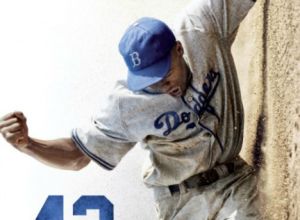

All Articles Tagged "jackie robinson"
From Jackie Robinson To Jason Collins: What’s Really The Big Deal About Being The First To Do Something?

There are lots of different discussions to be had around this Jason Collins story, particularly what does it mean to be the first of something?
According to the website True Blue LA, when asked to share his thoughts on Collins’ coming out, Don Mattingly, the current Dodgers manager, said, “It seems a little bit like a Jackie Robinson type thing to me. He’s kind of crossing some barriers,” Mattingly said. “It will be interesting to follow to see what happens.”
I’ve seen this comparison all throughout the media and the reaction to it has been pretty polarizing. As many people have noted, Collins is not the first openly gay athlete in sports. Last week, WNBA forward Brittney Griner came out rather casually and to little fanfare and/or criticism, and many other female athletes have done the same. Yet some have noted, the spectacle of his coming out might have something do with him being male and in a sport, which some would like to believe could come off more homophobic than the rest of society. Even still, it is hard to deny that there is a certain Robinson-esque quality to Collins’ story. And like the “first” before him, he will likely go down in history as an important trailblazer in the world of sports and sports politics. But outside of the historical significance, what is really the big deal about being the first?
Yvette Carnell, writer with Your Black World, noted recently that despite Robinson’s personal achievements, his inductions as a “first,” didn’t really serve the black community, outside of opening the doors for a few other black athletes to buy-in into a politically racist and socially unequal system (by way of professional baseball), which worked against the interests of black people. As pointed out by Carnell, while a big part of Robinson’s legacy hinges on him being the first, many folks are unaware of Robinson’s more patriotic and conservative leaning, which often was opposed to the general consensus of black folks at the time, including his support of Richard Nixon against John F. Kennedy for president; his testimony before the House Un-American Committee in hearings against black activist and artist Paul Robeson; and his support for the Vietnam War and inquiry into the patriotism of Dr. Martin Luther King when he announced his opposition to the war. She writes, “For some, celebrating Jackie Robinson’s integration into baseball boils down to the idea that blacks needed to be liked by even the most racist whites in order to have any real shot at the American dream. So to them, it was acceptable for Robinson to do whatever it took, even if it meant going so far as to unleash the Congressional hounds on Robeson, as long as it ensured that the doors to white baseball were opened to Robinson.”
There is no doubt that Collins out-coming will inspire more gay athletes, who have been hiding in the closet out of fear of reprisal, to not feel ashamed to live their lives publicly as well. And I imagine that it will also go a long way in changing mindsets – or at least creating the appearance of tolerance – and creating a more gay-friendly environment around that particular league. I can certainly see even the most hardened homophobic basketball fans willing to adjust their beliefs about gay men or gay rights–anything if it meant getting his/her team a championship. Heck, I know of a few of those such fans, who were very protective over Dennis Rodman – and he was a straight guy in a dress. However, outside of being able to identify with Collins, what exactly will his contributions be to advancing gay rights and equality outside of symbolism? In his essay in Sports Illustrated, Collins writes:
“The strain of hiding my sexuality became almost unbearable in March, when the U.S. Supreme Court heard arguments for and against same-sex marriage. Less then three miles from my apartment, nine jurists argued about my happiness and my future. Here was my chance to be heard, and I couldn’t say a thing. I didn’t want to answer questions and draw attention to myself. Not while I was still playing.”
As many people (including many folks in my timeline) would say, timing of his announcement matters. Collins is currently a free agent from the Washington Wizards. His stats put him, at best, as average in a league covered with top tier ballers. And as many have speculated, Collins’ out-coming could be of benefit to his fledgling career. But that’s all assuming that upper management, and its players, would be accepting of a gay teammate. And it is also assuming that even if they did manage to put aside prejudices and accept Collins with open arms, that he would be allowed to be as vocal politically on gay rights issues. What are the odds that the league would use him other than as a poster child for how far the National Basketball Association has progressed?
Historically speaking, a major part of Robinson’s appeal was his carefulness not to participate publicly on many issues and incidences related to blacks and civil rights while playing baseball in the mainstream professional league. Instead, he focused on home runs and helping his team win. It was that dedication to the game and overall carefulness, which served as the base for his squeaky-clean public image. Collins also acknowledges that his image too has a sort of contrary appeal to it and writes in his essay the following:
“I go against the gay stereotype, which is why I think a lot of players will be shocked: That guy is gay? But I’ve always been an aggressive player, even in high school. Am I so physical to prove that being gay doesn’t make you soft? Who knows? That’s something for a psychologist to unravel. My motivations, like my contributions, don’t show up in box scores, and frankly I don’t care about stats. Winning is what counts. I want to be evaluated as a team player.”
Like Robinson, being a team player is as of much importance as the relevance of his sexuality. In some respects, that is very admirable and at the very core of an equal society. It means that a person is truly being judged by his character and abilities, rather than some other arbitrary characteristic. However, as a culture, we are nowhere close to being equatable. And while Collins might be more in line with the dignified resilience of Robinson, what is probably needed to really push society forward is the righteous arrogance of a Muhammad Ali. It is also important to note the emphasis that Collins puts on being black in addition to being gay in the NBA in his Sports Illustrated essay. It means that despite the inroads made by Jackie Robinson, race – even when discussing sexuality in sports – remains largely a factor. We are reminded of this whenever we think about the dismal percentage of black coaches, owners and management in the NBA and college basketball compared to the percentage of players on the court. We’re also reminded of this when we read news reports about the deplorable conditions in which young ballplayers from Africa are forced to live in for the benefit of professional teams in the United States. Surprisingly, it was Bryant Gumbel, who during the last NBA lockout, compared league commissioner David Stern to a “modern plantation overseer, treating NBA men as if they were his boys …” That might be a first for Gumbel. But if he can be bold enough to speak that candidly, what is stopping others from doing the same?
’42′ And The Struggle For Dignity That Still Exists
Confession: Believe it or not, the reality of America’s racist past didn’t become real to me until college. (Insert gasp!) And I live in Georgia. (Insert disbelief and head shake.) While I grew up knowing about Martin Luther King Jr.—as my elementary history books glossed over the depths of slavery and segregation in America and presented him as the great savior that made all people get along now—I didn’t know much else. Stories of Malcolm X, W.E.B., and others came across my eyes by way of my mother, but my shallow understanding of racism and my upper middle class status left me thinking racism was a thing of the past that had no real effect on the present or future. Yes, I was downright ignorant.
It wasn’t until I went to college and practically minored in African American Studies (Why didn’t my counselor tell me I was one class away from having that credential?) that I found myself in my dorm room crying as I viewed pictures of lynchings and read articles that addressed racism as an institution whose effects have been deep and wide. America’s veil was torn. I realized that by those stars and stripes, we were not healed. But I was also awakened to the legacies of brave souls like Ida B. Wells, Frederick Douglass, and the countless individuals whose stories haven’t been told but to whom we owe our current freedoms. I’d never been more excited about academia than I was then, because I was discovering my own past. And a sense of responsibility, dignity, pride, and accountability to my ancestors filled my heart. There’s something about knowing scores of individuals either had to fight for or never had the opportunities you currently have (and possibly squander) that inspires greatness.
Seeing Jackie Robinson’s life depicted in “42,” this past weekend did just that. Watching the Major League Baseball player turn the other cheek while being barraged with racial slurs, letting the example of Jesus instruct him in the face of persecution, was nothing short of inspiring. But I couldn’t help but leave the film wondering whether my generation is too far removed to be inspired by such a film. Do these films become mere one-time experiences that have us reflecting for roughly a week but then going on about our business as usual afterward? I might sound like an old timer, but I think we’ve forgotten where we came from. And many young people have no real clue where that even is. We are growing up with a black president — dare we think we have arrived?
As I was also remembering MLK’s assassination on April 4, I couldn’t help but wonder how we’ve gone from a people who fought for our dignity and right to be educated — with our greatest threat coming from outside — to a people whose youth don’t see value in education or one other. Of course this is a generalization of a people of great accomplishment, and I realize that the effects of racism still stain us and affect our betterment, but is our culture headed for doom? Are we stuck on N***a Island? If so, how did we get here and is there any hope for getting off?
While “42″ finds Dodgers’ president Branch Rickey quoting Bible scriptures left and right, what the film doesn’t highlight is that it was Jackie Robinson’s own faith that gave him courage, and it’s what truly made him great. Perhaps that element of our culture has been lost, and we need to get it back. While he is keenly aware that there are no quick fixes to the many issues that plague African Americans, Sho Baraka (an artist whose Talented Xth album draws from W.E.B. DuBois’ work on how black culture can be uplifted), believes the decreasing importance of the black church has played a role in our decline. “I don’t believe the church is a important as it once was. Mainly because of the lack of a universal Black problem. Once Black people could comfortably live in suburbs with whites, their problems changed and we no longer have a common struggle.” Well, we know what Frederick Douglass had to say about that: “If there is no struggle, there is no progress.”
Am I saying we need to enter back into the chains of racial degradation? Heck no, we won’t go! But perhaps we have forgotten the lines of those ol’ negro spirituals that sung of our Great Emancipator as we find ourselves floating in that vast ocean of material prosperity MLK spoke of — unaware that we are headed towards a fool’s paradise. And our youth are paying the price. We need to remind ourselves of the struggle and educate our young people on our history. I don’t say that as a passing statement; I believe it plays an integral role in combating our current trajectory. We are as grateful for what we have today as we are cognizant of what we didn’t have the days before. We must remind them, because it will give them hope to become more. And we need them to have this hope because if “there ain’t no hope for our youth, then the truth is there ain’t hope for the future,” as 2pac so eloquently told us. They need to know that while entertainment and athletics are worthy arenas to aspire to thrive in, they can be more than rappers and athletes. They can be leaders and role models.
Jackie Robinson breaking into major league baseball is much more than a story of athletic prowess. It is a story of claiming and maintaining one’s dignity and having the guts to fight not with carnal, but divine weaponry. We must embark on that same fight for our people’s dignity. We owe it to those before us and behind us, and we owe it to ourselves. But most importantly, we owe it to the God who created us all equal.
Marriott Announces Special Tie-In To Jackie Robinson Flick ’42′ In Diversity Marketing Move

“42″ stars Chadwick Boseman and Harrison Ford at the White House this week. AP Photo/Jacquelyn Martin
Hoping to attract more African-American guests, Marriott International and Marriott Rewards, the company’s loyalty program, have teamed up with the folks behind the upcoming release of the film 42, which is based on the life of baseball legend Jackie Robinson, who broke the sport’s color barrier in 1947.
According to Target Market News, in support of 42, Marriott Rewards is putting travelers into the game with daily movie ticket giveaways and a chance to win exclusive access to the Hollywood premiere.
“42 is also a new and unique way for us to engage the 42 million members of our award-winning loyalty program and offer a special opportunity for them to experience the premiere and release of this important film,” said Ed French, senior vice president, Marriott Rewards, in a press statement. Also, on the company’s Facebook page, they created a souvenir 42 key card insert and worked with LodgeNet, the provider of in-room entertainment at many of their hotels nationwide, to promote 42 by airing a personalized message from Chadwick Boseman, who stars as Jackie Robinson, as well as the film’s trailer (below).
The Warner Bros. Pictures and Legendary Pictures film will hit theaters on April 12th and also stars Harrison Ford as Dodgers GM and President Branch Rickey and Nicole Beharie as Jackie’s wife, Rachel.
Marriott hopes the movie tie-in will help solidify a relationship with the African-American community. “This is the story of one man overcoming incredible odds to achieve his dream and open the door for African Americans during a troubled and divisive time in the country’s history,” said Apoorva Gandhi, vice president, multicultural markets and alliances, Marriott International. “We applaud its message of equality, inclusion and opportunity, which are values we embody in our Marriott culture.”
This isn’t the first venture by Marriott to highlight its commitment to diversity and inclusion. In fact, as we reported last fall Marriott International launched a multicultural marketing campaign targeting minority business travelers. Called “For You, We’re Marriott,” it was a $5 million effort to attract African-American, Hispanic, and LGBT travelers with ads that will run in print and digital outlets through the end of the year.
Prior to this, the company was the first in the travel industry to establish a formal diversity and inclusion program in 1989 and the first to introduce a formal supplier diversity program in 1997.
Black On The Big Screen: 9 Movies Coming Out in 2013 Featuring Black Hollywood
We always hear it’s hard for black actors and actresses in Hollywood, and we all know, not too many movies come out each year with a majority black cast, or even a black actor/actress as the lead. Despite the scarcity of roles for Black Hollywood, there are definitely films that will be representing for the brothers and sisters in 2013. The following are nine movies coming out this year that we know of so far, that feature Black actors.
Tags:
42, A Haunted House, After Earth, battle of the year in 3D, black films, black movies, black movies 2013, cedric the entertainer, chadwick boseman, Chris Brown, craig robinson, Dwanye Johnson, Essence Atkins, jackie robinson, Jaden Smith, josh holloway, Jurnee Smollett-Bell, Kerry Washington, Kevin Hart, kevin hart: let me explain, Lance Gross, Laz Alonso, Marlon Wayans, pain and gain, snitch, Terrance J, tyler perry's temptation, tyler perry's we the peeples, Will SmithStar of Jackie Robinson Biopic Talks “Opportunity Of A Lifetime” at ABFF Strikes for Education
If you haven’t heard of Chadwick Boseman yet, you will soon. The young actor has gotten what he calls “the opportunity of a lifetime” in playing Jackie Robinson, the legendary baseball player who broke Major League Baseball’s color barrier. We caught up with Boseman at The American Black Film Festival Strikes for Education event to discuss how he researched his exciting new role and prepared for the project.
More on Madame Noire!
- Beauty and the Braids: 7 Celebrities Who Make The Look Fierce
- Vain is Your Middle Name: Celebs Who Love Themselves as Much as Their Fans Do
- Do You Want What You Can’t Have? Why You Keep Chasing the Unavailable
- Tuesday Talk: Melanie Fiona On Her Mother, Man And One MF
- Tableside Racism: Waiters Admit Discriminating Against Black Patrons Because They Don’t Tip
- Ladies, What Do You Do With Your Farts?
- Why Don’t Black Women Want to Breastfeed?
- The 7 Reasons Men Lie, According To A Man Who Doesn’t (Maybe)
Who Should Play Jackie Robinson in the New Biopic?
Baseball great and trailblazer Jackie Robinson is the latest famous person to get the biopic treatment. Legendary Pictures (Inception, Hangover) is producing a film on the Robinson’s life. Robert Redford (if you haven’t seen him in 1974′s The Great Gatsby, go rectify that) has already been cast as Branch Rickey, the man who played an integral part in launching Robinson’s career in the big leagues.


