


All Articles Tagged "black business owners"
China Residents Make History By Opening First Black Beauty Salon In Beijing
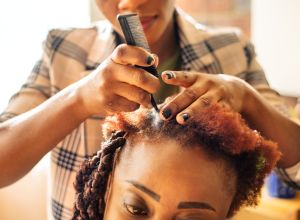
When Beijing resident Martha Makuena and husband Paul Luyeye realized that the Black hair market was severely under-served in China, they made history by deciding to fill in the gap and opening the Paulma Afro Hair Salon, reports BBC. Martha and her husband, who are originally from the Democratic Republic of Congo opened the salon in an effort to offer proper hair care to Beijing’s Black residents, but quickly found that Chinese locals were booking appointments and enjoying the benefits of the salon as well.
“When we go to local salons, they can’t do our hair. Local people’s hair is oily, but our hair dry. We need products to put on our hair, but local salons don’t have them,” Martha revealed to China Daily.
“The idea came to us because my wife has a diploma in hair dressing. She also has a diploma in fashion design. She knows all of these things and the idea came: Why not set up something like this official in Beijing so that we can help the African and African descendents?” said Paul.
“Everyone is welcome to have an African style in their hair. You might be Caucasian or Chinese or Indonesian. If you like our style, you are welcome and we can do it,” he continued.
Martha revealed that she moved to China in 1998, just two years after her husband’s job transferred him there. All of her children were born in China. For her, a large part of doing business in China is knowing the language, which she speaks fluently.
“Doing business in China is just a matter that you understand each other, the most important thing is the language. You have to understand and once you understand the language, you can understand the person… They don’t look at me as African, they look at me as a person… doing business,” she said.
Paul also shared that establishing a business in China was a bit challenging as investors are eluctant about entrusting their money to foreign businesses.
“It was not that easy. It was as hard as every company in China, as a foreign company when you want to invest, you have to go through a long process…I know it wasn’t easy, but if it were easy, everyone would do it.”
The Paulma Afro Hair Salon currently employs three women who are all from the Democratic Republic of Congo.
Amazing!
Check out Martha and Paul’s interview with BBC on the next page.
Black Businesses Get A Larger Portion of SBA Loan Money in the DC Area
The Small Business Administration, which talked up Small Business Saturday late last week, is putting its money where its mouth is with respect to black businesses.
During fiscal year 2012, black businesses were the only ones in the Washington DC area to see an increase in the number of loans they received from the government body, and the group to see the smallest decrease in the amount of money lent for the period.
According to the Washington Business Journal, African Americans got 14.5 percent of the loans administered for the year ending September 2012, an increase from the 10.4 percent the year before. (Black businesses had received 31.3 percent of the loans given in 2008 before taking a huge drop the following year to 17.6 percent.)
Moreover, the amount of money that was lent was up to 7.1 percent of the total given, up from 6.3 percent the two previous years.
The Washington Business Journal also lists the top lenders; the three biggest were M&T Bank (19 loans totaling about $1.8 million), BB&T (10 loans totaling $1.675 million), and Business Finance Group (five loans totaling $3.7 million).
Black businesses typically struggle for funding despite the entrepreneurial spirit that thrives in the African-American community. Let’s hope that other cities will see similar results.
Entrepreneur Spotlight: Costume Designer Ruth Carter

Synonymous with style, design and exquisite detail, Ruth E. Carter is the costume designer to call when a filmmaker needs to tell an authentic story though a characters’ attire and accessories. Getting her start in the theatre and in opera houses, Carter remembers getting her shot for the first time as a feature film costume designer from Spike Lee on the classic School Daze in 1988. Her portfolio today reads like that of a Hollywood A-Lister, with credits in over forty films, including classics as I’m Gonna Get U Sucka, The Five Heartbeats, Jungle Fever, Malcolm X, What’s Love Got to Do with It and most recently, Sparkle, which is scheduled to release in August 2012.
MN: What are the responsibilities of a costume designer?
RC: Essentially, the costume designer designs the look of the film. Most of the time people get that confused with a fashion designer and although we do work with fashion and we love fashion, it has more to do with coordinating the look of each character. Sometimes there is fashion that’s required and other times there’s not. You really have to know people and what makes people who they are through their clothes.
MN: We know that every film starts with the written word. How did you feel about the script for Sparkle?
RC: I’m always motivated about the story: if it moves me in some way, if it makes me laugh or makes me cry, just like you are in the movie theater. I like it for the same reasons in the script form. Once I read the script as I did with Sparkle, I was motivated by the 60s and Motown and that’s where my process started with researching the 60s and the Motown era. When I met with the [the director and writer] Salim and Mara Akil I bought images with me that I felt spoke to me.
MN: Where do you do your research? Do you start at Google like everyone else?
RC: Yeah. The same as everyone else, I go online and I spend hours on line looking at a lot of pictures. It’s different from when I first started back in the ole days. I’d start at the library or at the newsstand and spend money on magazines. Now, there are lots of magazine sites, fashion research sites that show you what people looked like in the 60s. It saves lots of time and money and it’s easier when it’s electronic so you can create your boards and ideabooks a lot faster. I still also enjoy the process of pulling tearsheets from magazines and putting together things physically to show my ideas.
“She’s The Boss” Episode 4 – Monif Clarke, Co-Founder & Designer of Monif C. Plus Sizes
About This Episode
Monif Clarke has an open heart, a big smile and she make clothes for curvy women. As the co-founder and owner of Monif C., Ms. Clarke was inspired by a European vacation to create a clothing line for full-figured women that was just as fabulous as the collections for women with more modest curves.
Watch and listen as Ms. Clarke dispenses priceless jewels about what it takes to make it in the fashion industry and how and where she gets her inspiration. Find out why she’s the boss!
Want More She’s The Boss? Check out these other episodes:
Former Model Making Sly Business Moves in P.I. field
When one thinks about private investigators, images from Hollywood may come to mind of men in trench coats with tiny cameras, slinking through the shadows in an effort to uncover top-secret information. Or the adventurous, Hawaiian island beach life of Magnum P.I. Well, some of that is true, but according to Brianne Joseph of Sly Fox Investigations in Baton Rouge, La., it’s far less glamorous than Hollywood makes it out to be.
“That’s not private investigation. There’s nothing glamorous about surveillance,” Joseph said. “Half the time I look like I just rolled out of my bed. Every day you’re in a van, it’s hot as hell, and you’re sweating in places you didn’t even know you had glands.”
Joseph, a 33 year-old New Orleans native, knows glamour. She maintained a successful modeling career before going into private investigation. Through two agencies in Louisiana, she had the chance to work with celebrities and musicians, including LL Cool J and Mariah Carey.
Hurricane Katrina destroyed all that Joseph and her family had in New Orleans and they had to sleep on an air mattress in the kitchen of a friend of a friend for six months in Lafayette before moving to Baton Rouge and starting over. After recovering from effects of the storm, Joseph made another big jump from modeling to private investigation.
“I graduated from Dillard University with a degree in business and always wanted to own a business, but I was modeling so much that I wanted to open a modeling agency,” Joseph said. “When I was introduced to private investigation through a friend, I realized how much women can have an advantage in that field. I had an awesome little modeling career, but I’ve moved on from it.”
Tenacity to uncover information and a determined work ethic are part of what make a great investigator, Joseph said.
“I’m the queen of plan B. That’s one of the most important characteristics a private investigator should have – the ability to find doors when they don’t seem to be there,” she said. “I’m able to search and research and I’m patient enough to wait for information.”
The field of private investigation is competitive and largely dominated by men, Joseph said. Women make up less than 15 percent of the 60,000 licensed private investigators in the U.S., according to the Journal of Professional Investigators.
Joseph set about learning all she could from veterans in the field, apprenticing under licensed investigators in other states. Companies in Louisiana were aware of Joseph’s desire to open an agency and weren’t keen on teaching tricks of the trade to their future competitor, she said. After five years under her belt working with other agencies, this past July Joseph decided to open her own agency and named it Sly Fox.
African Americans Only 1% of Internet Start-up Founders
(Black Web 2.0) – Black Web 2.0 has written about the importance of securing funding for Internet start-ups at various stages from the great idea to contracting the know-how to build it to the launch. Private investment research firm CB Insights has released its first ever Human Capital Venture Capital report. In part one of the report, the company takes an in-depth look into characteristics of the founders of venture-backed companies including race, age and experience, and the number of founders per company. The study covers the first six months of the fiscal year (Jan-Jun 2010) and focuses on Internet companies that secured their first round of funding. To further narrow the study, the geographical locations are focused on The Big Three in Internet funding: California, Massachusetts, and New York.
Q&A: Black Chamber Chief Has Advice For Government
(Houston Chronicle) — The National Black Chamber of Commerce, which represents 95,000 black-owned businesses, wraps up its annual conference today at the Four Seasons Hotel. Its CEO and co-founder, Harry Alford, took time during the gathering to discuss the state of small businesses with the Chronicle’s Salvador Rodriguez. Excerpts follow:
Entrepreneurship with Darnell Henderson
(Black Enterprise) — Henderson delivers all-natural men’s skincare products, including cleansers, toners, and scrubs, to the male masses. To date, H.I.M-istry is sold online and in more than 100 Macy’s department stores nationwide. In 2009, the enterprise produced revenues of $1.6 million and projects revenues of $2.3 million in 2010.
Reported by Census Bureau: Minority-Owned Business Surge
By Khadija Allen
Minority-owned business are on the rise in the economic report as they drive more than twice of all U.S businesses, according to the U.S Census Bureau. Economists, industry and public policy experts examined that minority companies comprise of a relatively small market and that they are thriving amidst the bleak job front and company losses.
African-American Business: Resources To Help You Grow
There are a variety of small business resources available that have been developed specifically to help African-Americans start and operate small businesses. African-American is defined here as persons living in the United States who are of African ancestry. Following are some resources available for African-Americans who run or want to run a small business.


