



All Articles Tagged "black books"
Our Favorite Movies Adapted From Black Books
Big screen adaptations of novels written by black authors are few and far between, which is precisely why we shouldn’t just support black movies, but black books as well – especially considering African-American achievements in literature are highly underrated. So definitely give these movies a watch, but do yourself one better and pick up the original books, because we already know that the movies are never ever as good as the original literary work
Books For Every Personality Type: Suggestions For The Reader/Non-Reader In Your Life

Shutterstock
According to published reports, in a PR blitz to promote Small Business Saturday, President Obama took his daughters to an independently owned bookstore for some holiday shopping. Am I the only one, who thinks that is pretty cool?
No not holiday shopping. Holiday shopping sucks – unless we are talking about the art of book gifting. Yes, I am that person. I love giving and receiving books as presents. But gifting books can be a tricky endeavor. While I am a firm believer that everybody is a reader, it does take a special book to bring that bookworm out of some folks. And all too often, booklovers will end up gifting a book, which they might enjoy, but it offers little to no interest to the special someone they are giving it to. So in the effort to help us bibliophiles during this holiday season, I have searched the bookshelf in my hallway to provide for you a list of 10 great book suggestions to impress even the most finicky of readers in your life.
Good News: First Lady Pens New Book, ‘American Grown’
Michelle Obama is working on a new book about her White House produce garden titled, “American Grown: How the White House Kitchen Garden Inspires Families, Schools and Communities.”
The book falls in line with the first lady’s campaign to reduce childhood obesity and will discuss how improving access to healthy, affordable food can improve eating habits and health overall.
Proceeds from the book, which is scheduled for release in April, will be donated to charity.
Will you pick up a copy of “American Grown?” It may seem impractical, but urban farming is actually a big trend, which can help you connect with family and save money on produce. An African-American man is even a pioneer of the urban farming movement. Now the first lady is on the bandwagon? Something to think about.
Brande Victorian is a blogger and culture writer in New York City. Follower her on Twitter at @be_vic.
More on Madame Noire!
- Why Aren’t They Married Yet? Celebrity Studs Over 40 We Wonder About
- Madame On the Street: Is Cheating Grounds for Immediate Divorce?
- What is Too Much? Ladies That Do the Most and Turn Men Off
- Why Your Guy Friend Is Not “Just A Friend”
- Your Fall/Winter Checklist For Keeping Your Hair Healthy
- The Luv Coach: School & Child – Or My Man?
Author Explores Black Female Stereotypes in “Sister Citizen”
It would be nice to think that we’ve gotten away from mammy and welfare queen imagery, but even a shallow look at black women’s portrayal in the media would tell you otherwise. The angry black woman is a stereotype most of us hate but some can’t break free of, and the strong black women archetype, or independent woman as we call it today, is a label we’ve come to embrace in many ways.
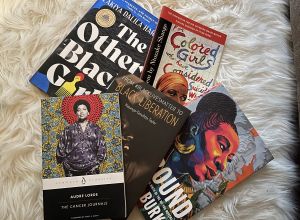
In her new book, Sister Citizen: Shame, Stereotypes and Black Women in America, columnist and Tulane University Political Science Professor Melissa Harris-Perry examines how black women are perceived in America and how these stereotypes affect the way we view ourselves.
The book’s main title is a nod to Audre Lorde’s “Sister Outsider,” a collection of essays focusing on race, gender, sexual identity, and social class. The subtitle, “For Colored Girls Who’ve Considered Politics When Being Strong Isn’t Enough,” refers to Ntozake Shange’s inspirational choreopoem, “For Colored Girls Who Have Considered Suicide When the Rainbow Is Enuf.”
“Fictive kinship” is one part of black women’s problem in terms of cultural and self-perception, Harris-Perry says. “The term fictive kinship refers to connections between members of a group who are unrelated by blood or marriage, but who nonetheless share reciprocal social or economic relationships. In this book, I draw on the deep tradition of black fictive kinship when I refer to black women as sisters. This imagined community of familial ties underscores a voluntary sense of shared identity.”
Tags:
black, black books, books, jezebel, mammy, melissa harris perry, Sister Citizen, sterotypes, women8 Urban Fiction Authors Who Overcame Prison And Forged Lucrative Careers
by Evette Brown
These former incarcerated authors turned their sentences into real-life experiences for millions of readers.
Dominating the Essence and New York Times bestsellers lists, respectively, street literature, officially recognized as urban fiction, has evolved into a permanent part of American literature. Telling the often tragic stories of African-American men trapped in the gritty realities of urban culture and the women who love them and become victims of vicious cycles, these novels have captivated many in the black community and beyond. With the success of street literature, many African-American authors have been transformed from street-savvy hustlers to literary inspirations and millionaires. Most of these prominent urban authors are using their life experiences to fuel their passion and words. Here, we feature eight urban authors who were once or are still incarcerated. They all have criminal histories, but now their experiences are used to prevent others from following down such a despairing path.
Wahida Clark
With the release of her 2005 acclaimed debut novel, Thugs and the Women who Love Them, the world was introduced to an emerging talent in urban fiction, Wahida Clark. The “Queen of Thug Love Fiction” immediately built a dedicated foundation of readers that were mesmerized with her depictions of a lifestyle that involved hustling, murder, and millions. Writing about the realities of the “ghetto,” where loyalty is more valuable than life, Clark used her words to create a literary empire.
Though the New Jersey native is one of the most popular authors writing street literature, for most of her Essence Bestselling career, she was once incarcerated in a women’s federal camp in Lexington, Kentucky. After reading a small portion of Shannon Holmes’ B-More Careful in XXL magazine, Clarke made the conscious decision to dedicate the remainder of her nine-year-sentence to creating the “Thug” series, thus sharing her experiences in life with the world. Since her release, Wahida Clark has used her position in literature to expose other urban authors to her audience. She is now the head of W. Clark Publishing and is now regarded as a savvy business woman and wise entrepreneur.
Street Lit Debate: Does Urban Fiction Undermine the Black Canon?
“Representing the race” remains a prickly issue in black literature
In the 40-plus years since Robert “Iceberg Slim” Beck released Pimp, the audience for so-called “street literature” has remained faithful to the genre, making bestsellers of Beck’s contemporaries and successors like Donald Goines, Omar Tyree, Teri Woods, and more recently Sister Souljah. But in 2008, after penning 16 novels, Tyree dramatically retired from the genre via a blog post.
“I’m done with writing all urban fiction,” he wrote, lamenting what he said was the “[urban audience’s] love for grit, crime, sex, broken hearts, drama, and other bullshit.” Calling his own work “urban classics,” Tyree juxtaposed street lit against what he termed “responsible lit.”
This debate rages on in the field of black publishing today. Toni Morrison, Alice Walker, and James Baldwin represent the African-American literary canon with their musings on race, feminism, and sexuality, while so-called “Street Lit” continues to occupy a controversial, but commercially successful spot in the hearts of African-Americans. Though most of us fall somewhere in the middle in reading preferences, the anxiety commonly felt about this contrast is not so much about the poles themselves, but distress over being defined solely by “low culture.” Centuries of being stereotyped will do that to a people.
Leading authors in this field see this struggle between telling gritty tales and promoting laudable writing as more complicated than judging street lit as all bad — or good.
Torrey Maldonado, author of Secret Saturdays does not appreciate the distinction of this label at all. “I’ve heard people call [the genre] ‘street lit’ and it kind of discredits the type of literature that it is,” he told The Atlanta Post. Maldonado, whose book is set in Brooklyn’s Red Hook Housing Projects, adds: “Although Secret Saturdays is set in an urban environment, it deals with universal themes… You can’t say because a black boy is on the cover of the book, that this book is only for black people.”
But that’s exactly what many people assume, says author David L who does not publish under his full name because he wants to keep his identity as an author separate from his role as head of the company Total Package Publications. “That’s one of the reasons I don’t even put my picture on the back of my book,” L explains. “I want to be known for the type of fiction I write, not because I’m an African-American author who wrote about a specific subject matter.”
High School Sweethearts Make the Write Choice
Does Bookstore’s Black Section Harm Black Books?
(AOL Black Voices) — “As an author and a former bookstore employee, anything that potentially makes a book harder to find could be a concern,” Danielle Evans, the author of the lauded Before You Suffocate Your Own Fool Self, told BlackVoices. “I have on occasion walked out of a bookstore or bought something else after not finding a book that I was looking for in the lit section, and then blocks away realized I should have asked if it was in the af-am section, because it can be hard to remember which stores shelve what where, and which stores have African-American sections.”
Sapphire Pens ‘Precious’ Sequel
(Philadelphia Inquirer) — She had to kill off Precious. That was what Sapphire, the 60-year-old author of the 1996 underground classic Push, the novel that was the basis for the unflinching movie Precious,concluded. The California-born literacy teacher, poet, and author had no choice, given her commitment to social realism: An HIV-infected black woman in the 1980s would not have lived long enough to make it past the first page of her sequel, The Kid (Penguin Press). So, the new book, to be published Tuesday, begins with Precious’ funeral. ”At the time Precious is diagnosed with HIV, African American women who were diagnosed with HIV were dying at a higher rate than white gay men,” said Sapphire, who will appear at the Free Library of Philadelphia at 7:30 p.m. Thursday. “For Precious to have made it as long as she did, to age 27, was a miracle.”
Ex-Con Makes a Scene (In a Good Way)
(Des Moines Register) — The author, the screenwriter and the producer grab a table in the back of the Ingersoll Avenue coffee shop and go to work. Papers, notecards and legal pads are strewn before them as they begin organizing the screenplay for the author’s first book. ”I keep coming back to the tough-minded authenticity here and the unapologetic tone,” says the screenwriter, James Serpento. “This is not the Hallmark story of a bad man gone good.” Not in the least. Amid all the shooting, stabbing, drinking, hustling, fleeing and turf protecting, there isn’t much to like about the protagonist in Alf Freddie Clark’s 2005 autobiography, “Satan’s Mask: A True Story of Deception, Murder, and Betrayal.”


